
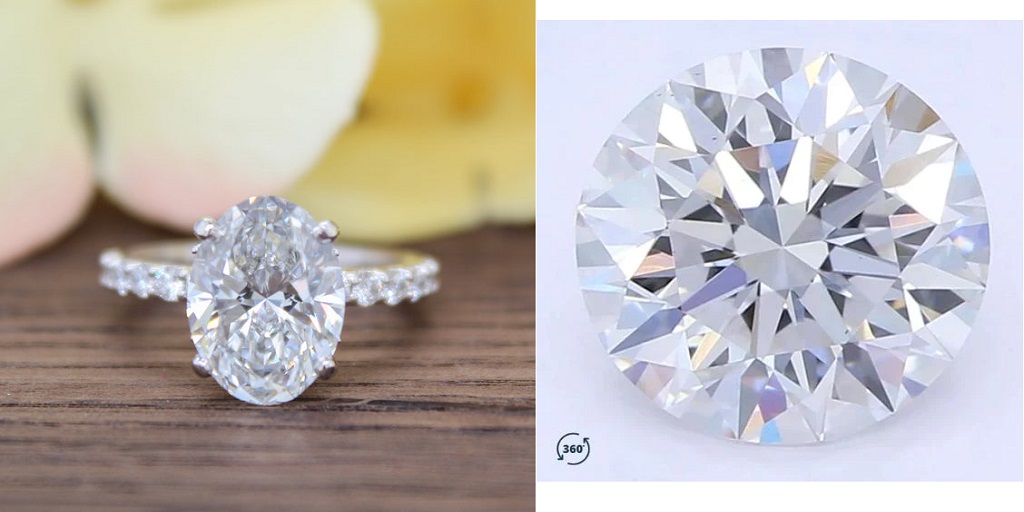
Modern buyers have more options than ever before. Way back when it used to be natural gemstones or nothing (not just including diamonds), options were limited. But today there is a wide range of natural and synthetic options, including lab grown diamonds (which are real diamonds, by the way) available for perusal.
This short guide will cover three of them.
Table of Contents
What Are Natural Diamonds and Why Are They So Popular?
Natural diamonds are an allotrope of carbon formed deep under the earth over the process of millions of years, under intense heat and pressure, which forces the carbon into a crystal lattice that is very stable and very hard.
When it is cut and polished appropriately, it is also very beautiful, which is one of the reasons that natural diamonds are so popular, along with their (relative) natural scarcity and exquisite natural allure.
Diamonds can be clear or colored and are available in a wide range of different cuts, all of which produce a different aesthetic appeal and fire, but there are other options in addition to natural diamonds, two of the best of which are moissanite and lab grown diamonds.
What Are Lab Grown Diamond Rings?
Lab grown diamonds are also real diamonds in the sense that they are chemically and physically indistinguishable from natural diamonds. The only difference between lab grown and natural diamonds is that the former, as the name would suggest, are produced in a lab.
The two main processes used to produce lab grown diamonds are HPHT, or “high pressure high temperature” in which extreme temperatures and pressures are used to compress carbon into a diamond, and CVD, or “chemical vapor deposition” in which carbon-rich gasses are used to deposit carbon on a diamond seed that accretes into a larger gem.
In addition to the fact that they are sustainable and more affordable, some of the other selling points of lab grown diamond rings is that there are fewer ethical concerns associated with their production, and that they, like natural diamonds, are available in a wide range of colors, cuts, and clarities.
What Is Moissanite?
Lastly we have moissanite, which is chemically distinct from a diamond, though it possesses many of the same physical properties. Technically speaking, moissanite is a mineral of the chemical formula silicon carbide.
While it does occur naturally, it is rare in the earth and most silicon carbide produced to form moissanite jewelry is made in a lab. It can be made quickly and cost-effectively, and like natural and lab grown diamonds, moissanite is available in a wide range of colors and cuts.
Another interesting fact about moissanite is that, while it is not physically or chemically the same as diamonds, it actually has superior refractive properties, which means that it produces more brilliant fire than both natural and lab grown diamonds. This is one of moissanite’s most distinguishing features.
To Learn More and Find Something Special and Unforgettable
Whether you’re interested in learning more about moissanite or natural or lab grown diamonds rings, or are looking for that special ring for your better half, visit Mikado Diamonds. They carry a wide range of natural diamond engagement rings as well as lab grown and moissanite rings, along with loose diamonds and other jewelry. Visit their website for more information or get in touch with them directly for additional help.
For More information About Unique Engagement Rings and Lab Grown Diamond Rings Please Visit: Mikado Diamonds.
