
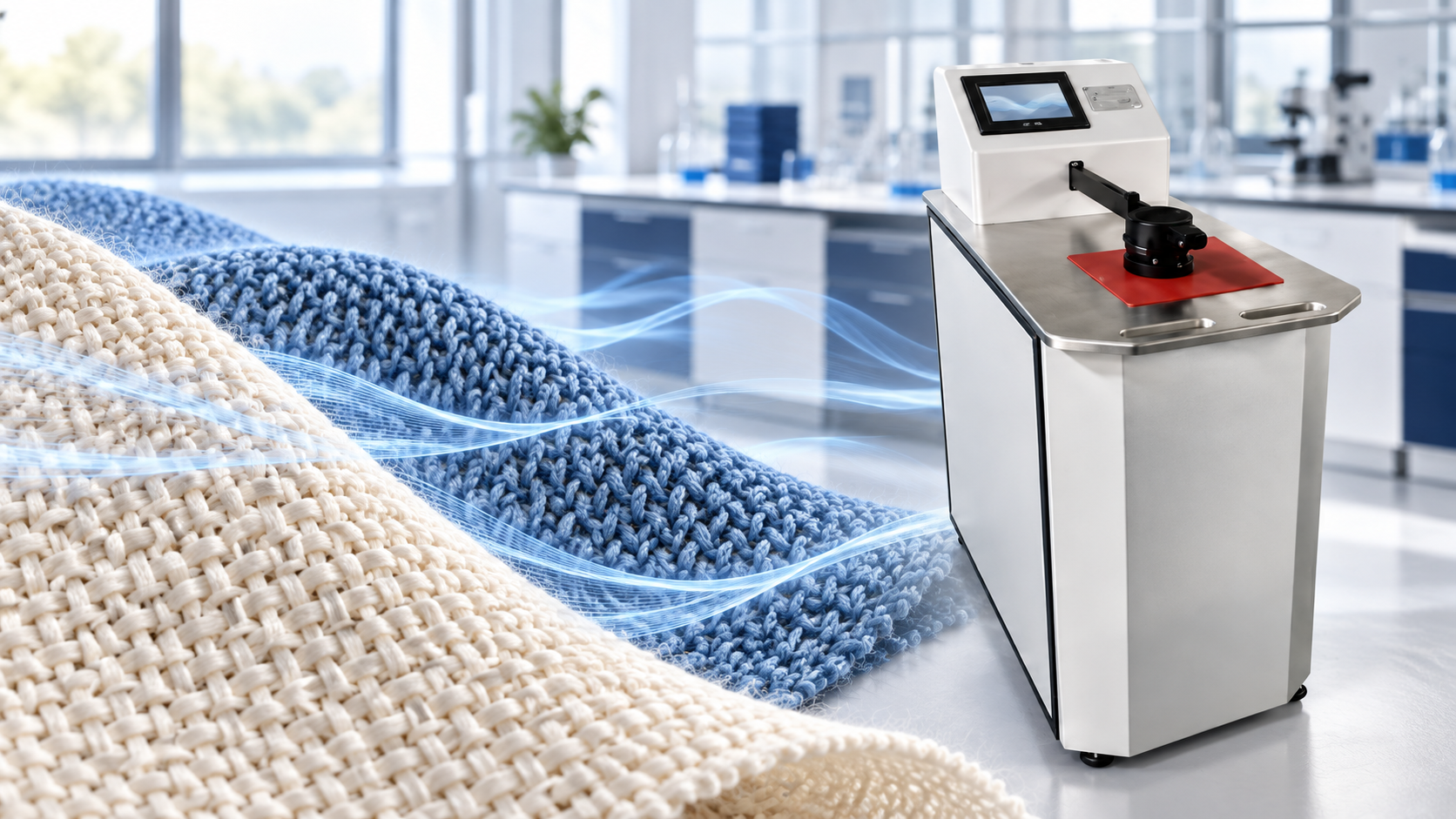
An Air Permeability Tester helps manufacturers measure how fabric construction affects airflow. The important question is not simply which fibre a fabric contains, but how its yarns, openings and layers form pathways through the finished material.
ASTM International identifies construction and finishing as factors that can change air permeability. This makes controlled measurement essential when comparing development samples, approving suppliers or investigating production differences. Source: ASTM D737
Table of Contents
What does fabric air permeability measure?
Fabric air permeability measures the airflow passing through a unit area of fabric under a specified pressure difference. It describes air passage through the tested specimen, rather than its fibre composition or appearance. The result therefore needs a pressure setting and reporting unit to have a clear meaning.
An Air Permeability Tester is an instrument that measures airflow through a defined material area under controlled pressure conditions. Apple Electroniks describes this measurement principle on its air and water vapour permeability testing page.
The basic relationship is:
Air permeability = volumetric airflow ÷ exposed specimen area
For an illustrative calculation, airflow of 0.2 litres per second through 20 cm², equivalent to 0.002 m², gives 100 L/m²/s. This is a calculated example, not a measured product result or recommended acceptance limit.
Air permeability also differs from water vapour transmission. Water vapour transmission is the passage of water in its gaseous state through a material. Apple Electroniks describes measuring this property through mass change over time using its WVP/S+ instrument. Source: WVP/S+ Water Vapour Permeability Tester
For a clear purchasing specification, identify which property matters:
- Airflow through the fabric.
- Water vapour transmission through the fabric.
- Both properties, measured separately.
Avoid using “breathability” as the only requirement. A named property, test method and acceptance criterion give the laboratory a more precise brief.
How do yarn arrangement and finishing influence airflow?
Yarn arrangement and finishing influence airflow by changing the openings between yarns and the routes through the fabric. Tighter packing can restrict those openings, while structural changes that create more open space can increase airflow. The outcome depends on the finished construction, so individual yarn characteristics cannot predict performance alone.
Yarn twist is the number of turns inserted into a yarn per unit length. ASTM D737 explains that greater twist may reduce yarn diameter and increase permeability, but may also enable closer packing that reduces it. Hot calendering can reduce permeability by flattening fabric components. Source: ASTM D737
| Structural change | Possible airflow effect | Relevant mechanism |
|---|---|---|
| Yarn diameter decreases | Increased airflow | More space may remain between yarns |
| Yarn packing becomes tighter | Reduced airflow | Openings become more restricted |
| Yarn extension opens the fabric | Increased airflow | Available open area increases |
| Hot calendering flattens components | Reduced airflow | Flow pathways change |
These are conditional mechanisms described by ASTM, not guaranteed rankings for every fabric. Source: ASTM D737, Sections 5.4–5.4.2
For a practical comparison, keep a construction record beside each result. Include yarn specification, thread arrangement and finishing state rather than relying on a weave name alone.
Published testing also illustrates the need to record measurement settings: Değirmenci and Çoruh used 100 Pa and a 20 cm² test area in their single-jersey investigation. These describe that experiment, not universal settings for all textiles. Source: Journal of Engineered Fibers and Fabrics
How does knitted loop length affect air permeability?
Knitted loop length affects air permeability by changing the size and arrangement of spaces within the knitted structure. Longer loops can produce a more open fabric, but yarn properties and knit architecture also influence the outcome. A measured improvement in one construction should not become a universal prediction for others.
Loop length is the length of yarn used to form a knitted loop.
Değirmenci and Çoruh examined single-jersey fabrics with loop lengths of 2.45, 2.6, 2.9 and 3.0 mm. Their experiment included cotton, polyester, acrylic and viscose, with the 3.0 mm polyester specimen showing the highest air permeability in the tested set. Source: single-jersey study
Research published in 2026 provides a further example. Nadiia Bukhonka’s study of pure flax Swiss double piqué knits reported that increasing average stitch length from 6.00 to 6.30 mm increased air permeability from 1,190.0 to 1,280.4 mm/s, approximately 7.6%. Source: Cellulose Chemistry and Technology
For development trials, treat loop length as an adjustable variable:
- Retain the same yarn specification across comparison samples.
- Record the knitting settings for each variant.
- Compare specimens after the same preparation and finishing.
- Evaluate airflow against the product’s other requirements.
Specify the target performance before selecting the preferred sample. The most useful construction is the one that meets the complete brief, rather than whichever specimen produces the highest airflow reading.
Why do pore connectivity and fabric layers matter?
Pore connectivity and fabric layers matter because air needs a continuous route through the material. A fabric may contain substantial internal space without offering an equally open path across its thickness. Layer arrangement can make airflow routes indirect, so total porosity does not fully describe measured air permeability.
Porosity is the proportion of a material’s volume occupied by voids. Pore connectivity is the extent to which those voids join to form continuous pathways.
A 2023 study in Polymers examined 8 interchanging double-cloth fabrics and considered effective porosity when interpreting airflow. Its specimens were tested over 100 cm² at pressure differences of 5, 10, 15, 20 and 25 Pa. Source: Incorporating Variable Porosity into the Determination of Effective Permeability in Interchanging Double Cloth Woven Fabrics Using Darcy’s Law
The research highlights why complex layered structures need more than a surface inspection: internal cavities and their connections influence the available flow routes. Source: double-cloth study
For layered-material projects, make the sample description explicit. Record which layers were present, their order and the direction of testing.
Useful questions for the development brief include:
- Was the complete assembly tested?
- Does the approved sample match the production layer arrangement?
- Are comparison results based on equivalent specimen preparation?
- Is the acceptance requirement for an individual layer or the assembled material?
These records make the result traceable. They also help prevent a measurement from one component being presented as evidence for a different finished assembly.
How should manufacturers compare fabric structures accurately?
Manufacturers should compare fabric structures using the same agreed test method, specimen preparation, pressure difference and exposed area. Construction details should accompany the readings so differences can be investigated. A controlled comparison is more useful than isolated numbers collected under conditions that vary between suppliers or laboratories.
Use the following workflow as a planning checklist; the selected standard remains the authority for the actual procedure:
- Define the comparison. Identify whether the trial concerns yarn arrangement, loop length, finishing or layer construction.
- Identify each specimen. Record its batch, composition, construction and processing state.
- Agree on preparation. Specify conditioning and any required pretreatment.
- Set the measurement conditions. Document pressure difference, exposed area, airflow direction and units.
- Follow the required sampling procedure. Use the specimen selection and number of readings specified by the method.
- Retain the results. Keep individual readings and the required summary statistics alongside the sample record.
Check units before interpreting differences. As an exact unit conversion, 1 L/m²/s equals 1 mm/s; changing between these units does not change the numerical value. Matching units, however, does not make results obtained at different pressures directly comparable.
For reporting, use one row per specimen and separate columns for settings, results and construction details. This makes missing information visible before a purchasing decision.
A useful supporting cluster article would be “How to Read an Air Permeability Test Report,” covering units, pressure settings, sampling and acceptance criteria.
How do you choose an Air Permeability Tester?
Choose an Air Permeability Tester by matching the required method, pressure settings, measurement range and specimen configuration to your materials. Reporting requirements also matter when comparing production batches. Begin with the test specification and expected samples, then confirm that the proposed instrument and accessories support that particular application.
Apple Electroniks lists the following specifications for its APT/Auto Air Permeability Tester:
- Test pressure: 10–3,500 Pa.
- Standard test area: 20 cm².
- Optional test areas: 5, 25, 38, 50 and 100 cm².
- Published measurement accuracy: ±2% of the displayed value.
- Reporting: automatic Excel report generation.
These are manufacturer-published specifications, rather than independent verification of performance in a particular laboratory. Source: Apple Electroniks APT/Auto specifications
Before requesting a quotation, prepare a short sample brief containing the required method, material types, expected airflow range and preferred reporting format. Ask the supplier to identify the configuration suitable for those requirements.
For further product information, explore:
- Air and water vapour permeability testing equipment.
- APT/Auto Air Permeability Tester specifications.
- Water vapour permeability testing for textile materials.
For an educational content cluster, link this article to a dedicated “What Is an Air Permeability Tester?” guide when available. That guide can explain instrument operation, while this article remains focused on how fabric structure influences the result.
What are common questions about fabric air permeability?
Common questions concern the relationship between construction and airflow, the meaning of test results and the equipment required. The answers below focus on those distinctions. A useful specification combines the measured property with its test conditions, rather than relying on fabric weight, fibre name or a general claim of breathability.
Does higher porosity always mean greater air permeability?
No. The connectivity and geometry of pores also influence airflow, particularly in layered constructions. Source: double-cloth permeability research
Does increasing yarn twist always reduce airflow?
No. ASTM explains that twist can either open inter-yarn spaces or enable tighter packing, depending on the resulting construction. Source: ASTM D737
Can increasing knitted loop length improve air permeability?
Yes, in some constructions. A 2026 flax double piqué study reported approximately 7.6% higher permeability when average stitch length increased from 6.00 to 6.30 mm. Source: flax knit study
Is fabric weight enough to predict airflow?
No. Specify a measured result alongside weight and construction details; knitted-fabric research evaluates multiple structural variables when explaining air permeability. Source: single-jersey research
Does an Air Permeability Tester measure water vapour transmission?
An airflow result does not measure water vapour transmission. Apple Electroniks lists separate instruments for these properties. Source: permeability testing range
What information should accompany an air permeability result?
Include the test method, pressure difference, exposed area, units, specimen identity and preparation conditions. Follow the selected method’s requirements for sampling, calculation and reporting.
