
Table of Contents
India Lingerie Market: Industry Report 2026–2034
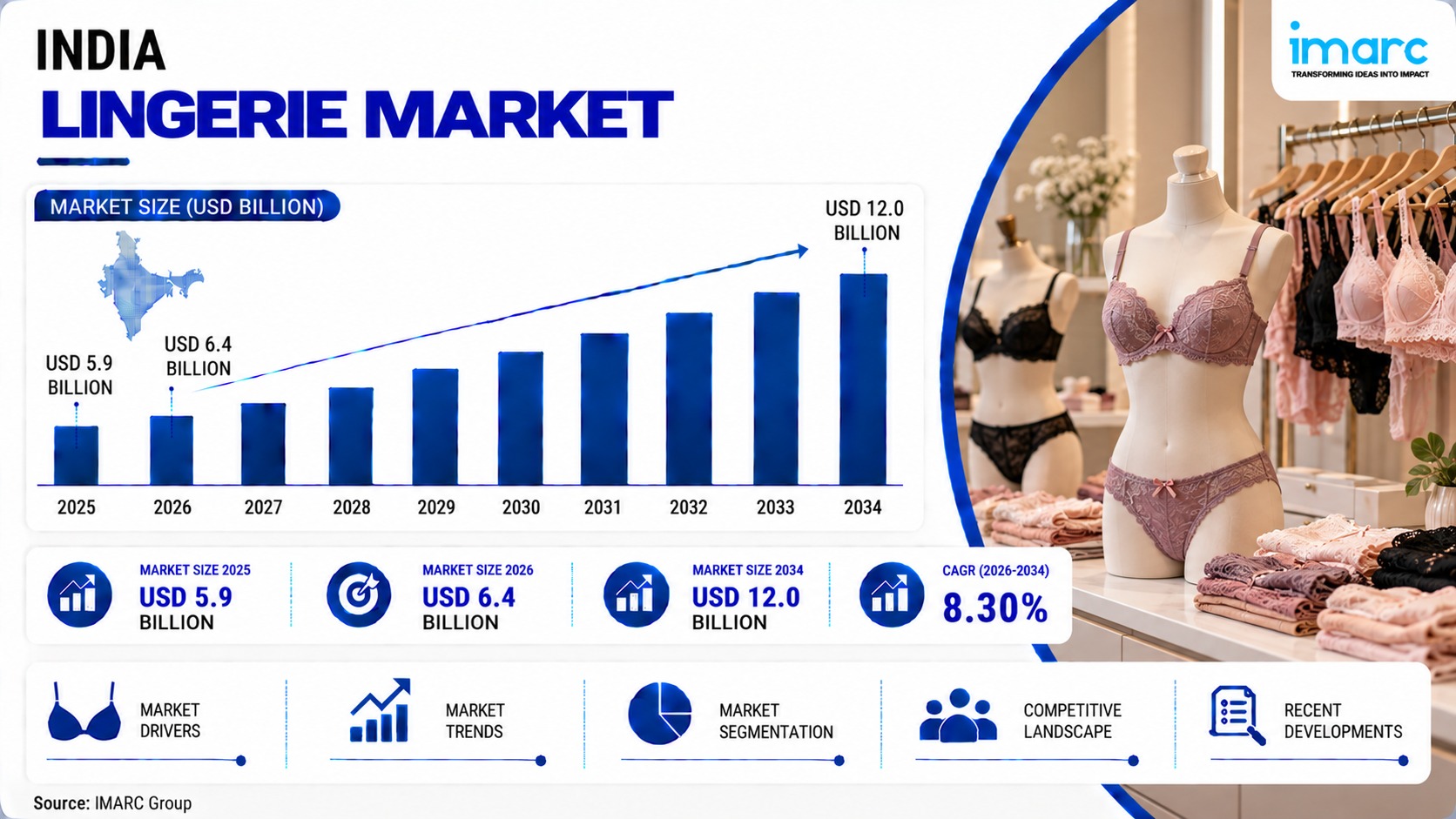
The India lingerie market size increased from USD 5.9 Billion in 2025 to USD 6.4 Billion in 2026 and is projected to reach USD 12.0 Billion by 2034, exhibiting a robust compound annual growth rate (CAGR) of 8.30% during the 2026–2034 forecast period. The industry is experiencing a profound behavioral and structural reset. Rather than being treated as a concealed, functional basic, intimate wear in India is evolving into a core component of daily wellness, personal ergonomics, and expressive fashion.
What Is the Size and Growth Forecast of the India Lingerie Market?
The market is exhibiting highly resilient, continuous expansion, fundamentally anchored by rising female workforce participation, changing societal mindsets, and the deep penetration of discreet online retail channels.
- Market Size in 2025: USD 5.9 Billion.
- Market Size in 2026: USD 6.4 Billion.
- Market Forecast in 2034: USD 12.0 Billion.
- Compound Annual Growth Rate (CAGR): 8.30% during the 2026–2034 forecast period.
- Underpinning Momentum: The rapid transition of consumers upgrading to specialized, activity-specific silhouettes ensures a continuous, high-volume domestic demand pipeline.
What Are the Latest Emerging Trends in the India Lingerie Market?
- Bonded, Wire-Free Ergonomics Replacing Rigid Underwires: A major paradigm shift is the rejection of restrictive underwires in favor of sonic-welded, bonded elastomeric support bands. These next-generation wireless bras use localized silicone micro-ribbing rather than metal hardware to provide structure, eliminating pinch marks while maintaining the lifting silhouette demanded under both Indian ethnic wear and Western business formals.
- Ethnic-Wear Compatibility Engineering: Mainstream intimate wear has historically been designed around Western silhouettes. Domestic brands are actively designing specialized lingerie engineered explicitly for Indian ethnic attire—such as targeted side-smoothing brassieres for tailored saree blouses, seamless microfiber saree shapewear that replaces drawstring petticoats to eliminate waist chafing, and plunge-back bralettes with built-in bust support.
- “Skin-Climate” Micro-Modal and Tencel Blends: While pure cotton remains a baseline staple, manufacturers are rapidly pivoting toward eco-friendly regenerated cellulosic fibers like Micro-Modal and Tencel blended with fine-denier spandex. These fabrics deliver significantly higher moisture-absorption rates, dry faster in humid weather, and resist the fabric pilling common with daily handwashing, creating a premiumized tier within the daily-essentials bracket.
- Discreet “Dark-Store” Quick-Commerce Deliveries: The friction of buying intimate wear in physical stores or waiting days for postal packages is being dismantled by ultra-fast delivery. Leading quick-commerce platforms are stocking top-selling size profiles (such as 32B to 38C in basic black, nude, and white) in local fulfillment centers, enabling discreet, unbranded paper-bag deliveries within 10 to 15 minutes for emergency wardrobe fixes.
- Data-Driven Custom Modular Sizing: With Indian women frequently falling outside traditional US/UK sister-size frameworks, D2C brands are moving away from static alphabetic cup sizing. Companies are adopting three-dimensional measurement matrixes that account for narrower ribcages and fuller bust profiles, offering modular features like interchangeable multi-width back bands and dual-strap tension adjustments to reduce online return rates.
Grab a sample copy of this report: https://www.imarcgroup.com/india-lingerie-market/requestsample
What Growth Factors Are Driving the India Lingerie Market?
- Wardrobe Specialization and Segment Diversification: The historical pattern of owning 3–4 generic brassieres for all occasions has been completely replaced by high-rotation wardrobe compartmentalization. Indian consumers now maintain distinct sub-inventories for activewear (high-impact sports bras), daily desk work (seamless T-shirt bras), lounge hours (cotton bralettes), and festive occasions (backless and deep-neck options), multiplying per-capita annual unit purchases.
- Expansion of White-Collar Corporate and GCC Corridors: The massive influx of multinational corporations and Global Capability Centers (GCCs) across Tier-1 and emerging Tier-2 tech hubs has created a large demographic of financially independent, professional women. Long working hours and daily commutes create an inelastic demand for premium, anti-chafing, and ergonomically engineered intimate apparel that ensures 12+ hours of continuous comfort.
- Destigmatization Through Digital-First Experiential Commerce: The proliferation of female-centric shopping environments—both private mobile apps with confidential sizing algorithms and well-lit, all-female-staffed Exclusive Brand Outlets (EBOs) in retail malls—has stripped away the cultural awkwardness of shopping at male-operated neighborhood hosiery counters, unlocking substantial pent-up demand.
- Tier-2 and Tier-3 Aspirational Modernization: Access to fashion content via social platforms, combined with nationwide delivery logistics, has ignited aspirational consumption in smaller cities. Consumers across non-metro urban clusters are leapfrogging unbranded local market goods directly into structured, branded lingerie portfolios that promise reliable sizing and modern aesthetics.
- Rising Focus on Active Lifestyles and Gym Culture: Rapidly growing health awareness and gym memberships among urban women have elevated sports bras from a niche performance item to an essential everyday category. Because high-impact physical training requires specialized bounce-control support, consumers actively spend higher price premiums on dedicated activewear lines rather than compromising with standard loungewear.
What Are the Key Challenges Facing the India Lingerie Market?
- Complex SKU Proliferation and Inventory Carrying Costs: Lingerie retail is uniquely burdened by the necessity to stock dozens of size variations (combining band and cup sizes across multiple colors) for a single design. This extreme SKU proliferation leads to inventory deadstock, stockouts in popular sizes, and high warehousing costs, compressing operating margins for emerging brands.
- Persistent Footprint of Low-Cost Unorganized Producers: Despite rapid formalization, an extensive segment of the market remains controlled by fragmented, unorganized manufacturers in traditional textile hubs. By bypassing quality certifications, specialized testing, and standardized sizing, these players flood local markets with cheap alternatives that undercut organized retail pricing.
Explore the Full Report with Charts, Table of Contents, and List of Figures: https://www.imarcgroup.com/india-lingerie-market
Deep-Dive Segment Insights:
The market is meticulously segmented across product types, material compositions, pricing tiers, and distribution channels.
By Product Type
- Brassiere (46.0% in 2025): The absolute dominant segment, driven by essential functional support, shape enhancement, and rapid product diversification (such as padded, wireless, multiway, and sports variants).
- Knickers or Panties: Represents the highest-volume, highest-frequency replenishment segment, driven by multi-pack retail offerings and expanding demand for seamless laser-cut finishes.
- Shapewear & Others: Growing rapidly, heavily anchored by targeted compression wear for ethnic sarees, festive lehengas, and western evening wear.
By Material
- Cotton (40.0% in 2025): Holds the clear majority share due to its natural breathability, skin safety, and comfort in hot, tropical climates.
- Synthetics and Blends (Nylon, Modal, Spandex): Rapidly expanding in the sports, seamless, and lace categories, favored for extreme stretch, moisture-wicking capabilities, and wrinkle resistance.
By Price Range
- Economy (69.0% in 2025): Dominates total volume demand across middle-income households and non-metro retail counters.
- Premium: Experiencing strong value-driven growth in metro centers, supported by rising disposable incomes, imported luxury labels, and higher spending power among corporate professionals.
By Distribution Channel
- Mass Merchandizers & Multi-Brand Stores (47.0% in 2025): Account for the largest distribution volume due to wide regional availability and extensive price ranges.
- Online Platforms & Exclusive Outlets: Exhibiting the most rapid growth, offering absolute privacy, virtual fit assistance, and direct-to-door deliveries.
By Region
- North India (33.0% in 2025): Represents the largest regional market, driven by heavy retail density, higher disposable incomes, and concentrated urban expansion across Delhi-NCR and major commercial cities.
- South, West, and East India: Southern and Western markets follow closely, heavily propelled by high concentrations of female corporate professionals and progressive urban cultures in Bengaluru, Mumbai, and Pune.
Competitive Landscape & Key Player Positioning:
Covering an in-depth analysis of the competitive landscape, market structure, key player positioning, competitive dashboards, top winning strategies, and detailed profiles of all major industry participants you will gain access to all these exclusive insights within the full research report.
Recent Developments:
- Expansion of Inclusive and Specialized Silhouettes: Domestic brands expanded their portfolios to address previously neglected segments, heavily launching dedicated post-surgical, maternity nursing, and teen-starter ranges designed specifically to build long-term brand loyalty early in the consumer lifecycle.
- Consolidation of Intimate Wear Under Organized Retail: Large conglomerates like Reliance Retail accelerated the integration of acquired digital-first brands (including Zivame, Clovia, and Amanté) into large-format physical department stores and hypermarkets, expanding high-margin private label shelf space.
- Scaling of Antimicrobial and Odor-Resistant Finishes: Manufacturers introduced silver-ion and bio-based antimicrobial coatings to inner linings, specifically formulated to maintain fabric freshness and skin health during prolonged Indian summer humidity.
Customization Note: If you require any specific information not covered within this report’s scope, we will provide it as part of the customization.
Request Report Customization: https://www.imarcgroup.com/request?type=report&id=4579&flag=E
FAQs
Q1. What is the current size of the India lingerie market?
The India lingerie market size increased from USD 5.9 Billion in 2025 to an estimated USD 6.4 Billion in 2026.
Q2. What is the projected market size by 2034 and the CAGR?
The market is projected to reach USD 12.0 Billion by 2034, exhibiting a compound annual growth rate (CAGR of 8.30%) during the 2026–2034 forecast period.
Q3. Which product category holds the largest market share?
The Brassiere segment leads the industry with a 46.0% share (2025), supported by high functional necessity, regular replacement cycles, and widespread adoption of specialized everyday and sports designs.
Q4. Which material dominates the Indian market?
Cotton leads with a 40.0% market share (2025) due to its breathability, natural comfort, and suitability for India’s tropical climate conditions.
Q5. Which region commands the highest sales volume in India?
North India leads the market with a 33.0% share (2025), fueled by high urban population density, established retail infrastructure, and elevated disposable income levels across major metro centers.
