
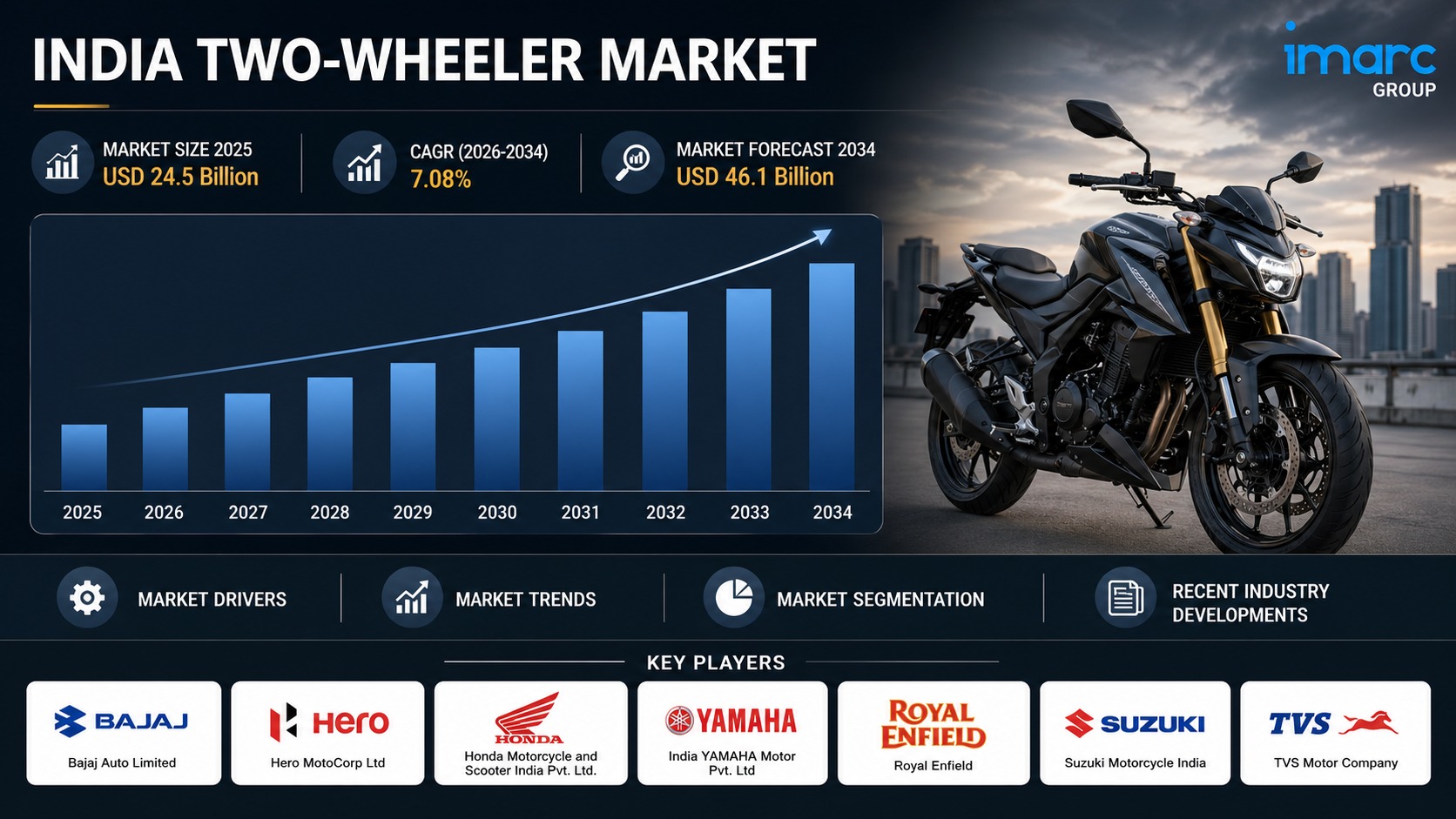
According to IMARC Group’s report titled “India Two-Wheeler Market Size, Share, Trends and Forecast by Type, Technology, Transmission, Engine Capacity, Fuel Type, End User, Distribution Channel, and Region, 2026-2034“, the report offers a comprehensive analysis of the industry, including market forecast, growth, share analysis, and regional insights.
Two wheeler industry growth in India is unfolding at a scale that few consumer sectors can match the market reached USD 24.5 Billion in 2025 and is projected to reach USD 46.1 Billion by 2034, growing at a CAGR of 7.08%. In October 2025 alone, retail sales exceeded 2.8 million units in a single month, led by Hero MotoCorp, TVS, and Bajaj Auto, with electric scooter and premium motorcycle segments recording significant acceleration within that volume.
- Motorcycles lead by type at 56% share, with Hero MotoCorp selling 6,04,490 units in November 2025 alone a 31% year-on-year increase reflecting the category’s extraordinary volume depth.
- ICE technology commands 90% share while electric two-wheelers are growing fast, with Ola Electric becoming the first two-wheeler EV manufacturer to receive PLI-Auto Scheme incentives in March 2025, securing Rs 73.74 crore for FY2023-24.
- The 100-125cc engine capacity segment leads at 42% share with Honda Motorcycle and Scooter India targeting expansion of its 28% market share through two new launches in this range in August 2025.
- West and Central India leads regionally at 34%, while offline distribution holds 89% of channel share as physical dealerships remain the dominant purchase environment.
- Kinetic Green announced plans in July 2025 to launch three new e-scooters over the next 18 months, developed with Italy’s Torino Design, signaling continued EV portfolio investment across both established and emerging manufacturers.
Table of Contents
The Strategic Market Challenge: Navigating the Two-Wheeler Market in India
The most consequential friction point in India’s two-wheeler market is infrastructure asymmetry. Public transportation lags population growth in most cities, which drives two-wheeler adoption but simultaneously, fuel station scarcity in rural areas, sparse dealership coverage in semi-urban markets, and limited EV charging networks outside metro centers create geographic ceiling effects on growth velocity. Rural and semi-urban India represents enormous untapped demand, but poor roads, limited service access, and seasonal connectivity disruptions increase ownership costs and reduce practical vehicle utility precisely in the regions where two wheelers are most needed as affordable personal transport.
What’s Driving Two Wheeler Industry Growth in India:
Two wheeler industry growth in India is being powered by a convergence of demographic, economic, and policy factors that are unlikely to weaken over the forecast period:
- India’s urbanization wave is pushing millions into cities with inadequate public transit, making two-wheelers the default personal mobility solution for daily commuting among working-class and middle-income households.
- Rising middle-class purchasing power supported by dual-income households and fintech-enabled EMI financing is making aspirational vehicle ownership accessible to segments that previously depended on second-hand markets.
- The PLI scheme’s incentives for domestic EV manufacturing, Ola Electric’s PLI certification, and Yamaha’s November 2025 launch of the AEROX E and EC-06 electric scooters reflect sustained OEM investment in the next phase of market growth.
- Hero MotoCorp’s Vida VX2 battery subscription model and Honda’s establishment of Honda Finance India in August 2025 as its ninth global financial services subsidiary are creating ownership access models that expand the buyer base beyond traditional full-purchase consumers.
➤ Access Industry-Focused Insights and Future Forecasts – Request Sample Report
India Two-Wheeler Market Trends & Future Outlook:
- The connected vehicle trend, exemplified by MediaTek and JioThings’ Made-in-India smart digital cluster with voice recognition and real-time diagnostics, is making technology integration a competitive baseline expectation across mid-range and premium two-wheelers.
- Premium motorcycle and scooter demand among urban consumers is accelerating as two-wheelers increasingly function as identity and status markers alongside transportation tools.
- Electric two-wheelers will capture growing share of new sales as charging infrastructure expands and OEM EV portfolios deepen Yamaha’s dual-launch strategy in November 2025 and Kinetic Green’s three-model pipeline through 2026 both reflect genuine product commitment rather than token EV positioning.
- The 126-250cc engine capacity segment is growing faster than the dominant 100-125cc range as premium aspiration and commuter upgrading pull buyers upward through the displacement ladder.
- Organized used-vehicle platforms offering quality assurances and warranties are formalizing secondary markets, creating a complementary growth channel that expands total industry participation without directly competing with new vehicle sales.
Regulatory Landscape & Policy Catalysts in India:
- PLI Scheme for Two-Wheeler EV Manufacturing (Ministry of Heavy Industries): Ola Electric’s Rs 73.74 crore PLI incentive in March 2025 validates the scheme’s commercial traction, incentivizing domestic EV manufacturing scale-up and encouraging other manufacturers to meet qualifying production benchmarks.
- PM E-DRIVE Program: Subsidies reducing EV acquisition costs are directly supporting electric two-wheeler adoption, accelerating the segment’s growth above the overall market CAGR and incentivizing OEM investment in domestic EV product development.
- Bharat Stage 6 Phase 2 (BS6 Phase 2) Emission Norms: Tighter real-driving emission controls effective from April 2023 are raising the technical bar for ICE engine efficiency and pushing manufacturers toward cleaner combustion technologies that benefit consumers through better fuel economy.
- Rural Road Infrastructure PM Gram Sadak Yojana: Improved rural road connectivity is expanding the practical utility of two-wheelers in semi-urban and rural areas, growing the addressable market beyond metro and tier-1 city consumers who currently dominate sales volumes.
- Automotive Component Localization Policy: Government support for domestic component manufacturing is improving supply chain resilience and cost competitiveness for two-wheeler OEMs, reducing import exposure for critical parts across both ICE and EV powertrains.
By the IMARC Group, the Top Competitive Landscape & their Positioning:
- Bajaj Auto Limited
- Hero MotoCorp Ltd
- Honda Motorcycle and Scooter India Pvt. Ltd.
- India YAMAHA Motor Pvt. Ltd
- Royal Enfield
- Suzuki Motorcycle India
- TVS Motor Company
Covering an in-depth analysis of the competitive landscape, market structure, key player positioning, competitive dashboards, top winning strategies, and detailed profiles of all major industry participants you will gain access to all these exclusive insights within the full research report.
➤ Explore the Complete TOC and Data Coverage – Get Full Brochure
Market Segmentation Breakdown and Share Analysis:
Analysis by Type:
- Motorcycle
- Scooters
- Mopeds
- Electric Two-Wheeler
Motorcycles dominate the market with a 56% share in 2025, supported by their versatility for both urban and long-distance travel, affordability, and strong preference among budget-conscious middle- and lower-income consumers nationwide.
Analysis by Technology:
- ICE
- Electric
Internal combustion engine (ICE) vehicles account for 90% of the market in 2025, driven by well-established refueling infrastructure, consumer familiarity, lower upfront costs, and extensive service networks across urban and rural regions.
Analysis by Transmission:
- Manual
- Automatic
Manual transmission leads with a 78% market share in 2025, reflecting consumer preference for better fuel efficiency, lower maintenance expenses, greater riding control, and cost-effective commuting solutions.
Analysis by Engine Capacity:
- 100-125cc
- <100cc
- 126-150cc
- 151-200cc
- 201-500cc
- 500cc
The 100–125cc segment holds a 42% share in 2025, owing to its optimal balance of fuel efficiency and adequate power, making it suitable for daily commuting in congested cities and longer rural routes.
Analysis by Fuel Type:
- Petrol
- Electric
- Others
Petrol-powered vehicles dominate with a 47% share in 2025, supported by widespread fuel availability, mature supply chains, competitive pricing, and high consumer confidence in conventional fuel options.
Analysis by End User:
- Personal
- Commercial
Personal usage accounts for 94% of the market in 2025, driven by rising demand for individual mobility, urban traffic congestion, limited public transport, and growing ownership aspirations among young professionals.
Analysis by Distribution Channel:
- Offline
- Online
Offline channels lead with an 89% market share in 2025, as consumers continue to value physical inspection, test rides, assured after-sales service, and personalized dealer engagement.
Regional Insights:
- West and Central India
- North India
- South India
- East India
West and Central India hold the largest share at 34% in 2025, fueled by dense metropolitan populations, industrial expansion, favorable economic conditions, and increasing purchasing power driving private vehicle adoption.
Note: If you need specific information that is not currently within the scope of the report, we can provide it to you as a part of the customization.
➤ Tailor the Research to Your Exact Business Needs – Request Customization
Frequently Asked Questions (FAQs):
Q1: What is the current value and projected growth of the India Two-Wheeler Market?
According to IMARC Group, the India two-wheeler market reached USD 24.5 Billion in 2025 and is projected to reach USD 46.1 Billion by 2034, growing at a CAGR of 7.08% over the forecast period 2026-2034.
Q2: Which type and technology segments lead the market?
Motorcycles lead at 56% type share, driven by versatility across urban commuting and long-distance travel. ICE technology holds 90% share, supported by established fuel infrastructure and lower upfront costs. Electric two-wheelers, while at a smaller share, are the fastest-growing technology segment.
Q3: Which engine capacity and fuel type dominate demand?
The 100-125cc segment leads at 42% share, offering optimal fuel economy and sufficient power for daily commuting. Petrol leads fuel type at 47%, supported by nationwide station availability. Honda’s August 2025 launches in the 100cc and 125cc segments reflect how fiercely competed this mainstream displacement range remains.
Q4: How are flexible ownership models changing the market?
Battery subscription services like Hero MotoCorp’s Vida VX2, fintech-embedded financing at dealerships, and Honda Finance India’s retail lending launch in August 2025 are collectively lowering the ownership entry barrier. These models expand the effective buyer base without requiring OEMs to reduce vehicle prices.
Q5: Which companies lead India’s two-wheeler market and what are they doing in EVs?
Hero MotoCorp leads in volume with 6,04,490 units in November 2025. Honda targets 30% market share by 2030 with a focus on female riders. Yamaha launched the AEROX E and EC-06 in November 2025. Ola Electric received PLI scheme incentives in March 2025. Kinetic Green announced three new e-scooter models in partnership with Torino Design in July 2025.
Strategic Insight & Verdict
Two wheeler industry growth in India is entering a phase where volume momentum, EV transition, and premiumization are all accelerating simultaneously a combination that rarely occurs in a single market. The infrastructure constraints are real but being addressed through policy and private investment. Based on segment dynamics and manufacturer investment patterns, we at IMARC Group have observed that OEMs and component suppliers with positions across ICE commuter volume, EV platforms, and connected vehicle technology are best placed to capture value as this market grows from USD 24.5 Billion toward USD 46.1 Billion by 2034.
Verified Data Source: India Two-Wheeler Market Report by IMARC Group
