
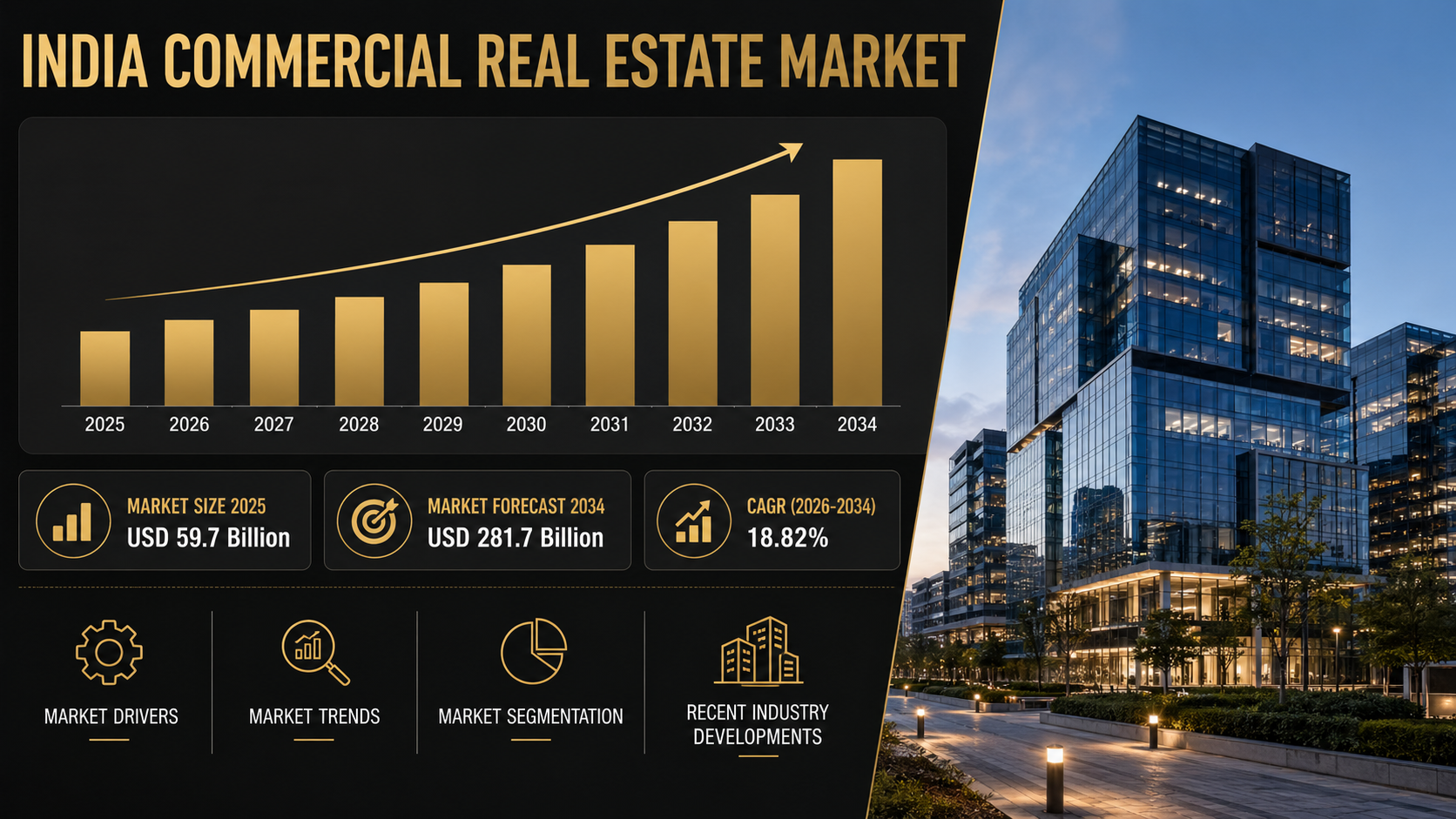
As indicated in the latest market research report published by IMARC Group, titled “India Commercial Real Estate Market Size, Share, Trends and Forecast by Type, End Use, and Region, 2026-2034,” the report presents a thorough review featuring the market share, trends, growth, and research of the industry.
The commercial real estate market size in india was valued USD 59.7 Billion in 2025. By 2034, this figure is projected to reach around USD 281.7 Billion, with a compound annual growth rate (CAGR) of 18.82% over the forecast period (2026-2034).
India’s transition from a conventional back-office hub to a global destination for high-value, tech-integrated Grade-A commercial assets is fundamentally disrupting institutional investment portfolios.
- The India Commercial Real Estate Market was valued at USD 59.7 Billion in 2025 and is projected to scale to an unprecedented USD 281.7 Billion by 2034, registering an explosive 18.82% CAGR.
- Global Capability Centers (GCCs) act as the primary demand anchors, with over 1,600 centers currently operational, fiercely driving the absorption of premium office spaces across metropolitan hubs.
- The hybrid work model has institutionalized flexible workspaces, with total flex stock in India expected to cross a massive 85 million sq ft by the end of 2026.
- India’s commercial sector is witnessing a massive ESG pivot, retaining its third-place global ranking for LEED certifications in 2024 by adding 370 green projects spanning 8.5 million gross square meters.
- The rapid proliferation of Real Estate Investment Trusts (REITs) and RERA regulations is democratizing market participation, significantly enhancing transparency, liquidity, and global governance standards for BFSI investors.
Table of Contents
The CXO Blindspot: How the India Commercial Real Estate Market is Reshaping the BFSI Sector in India
The Blindspot: The Severe Financial Liability of Non-ESG Compliant, Legacy Commercial Portfolios BFSI leaders, portfolio managers, and institutional investors are drastically underestimating the financial and regulatory risk of holding onto aging, rigid, and non-ESG compliant commercial real estate. With multinational corporations strictly mandating LEED and IGBC-certified properties to meet global carbon goals, legacy assets lacking AI-driven energy management and flexible floor plans are rapidly becoming stranded assets. The blindspot lies in delaying the divestment or modernization of these low-grade properties under the false assumption that traditional location advantages will continue to sustain historic rental yields.
Ignoring this structural transition creates a severe ripple effect across India’s broader BFSI sector. Financial institutions and portfolio managers holding onto non-ESG compliant, rigid legacy assets risk massive devaluation, stagnant rental yields, and stringent regulatory penalties. This oversight inherently disrupts long-term investment liquidity, delays institutional capital inflows, and ultimately erodes corporate profit margins as global corporate tenants and sovereign wealth funds aggressively mandate green-certified, AI-driven commercial spaces for their operational footprint.
➤ Access Industry-Focused Insights and Future Forecasts – Request Sample Report: https://www.imarcgroup.com/india-commercial-real-estate-market/requestsample
India’s Strategic Vision for the Commercial Real Estate Market:
- Institutionalizing Liquidity via REITs: Expanding the Real Estate Investment Trust framework to formalize Grade-A assets, attract global private equity, and provide highly liquid, secure exit strategies for institutional capital.
- Sustainable & ESG-Compliant Corridors: Enforcing stringent energy-efficient designs and renewable energy integration, propelling the nation’s commitment to green building certifications (LEED/IGBC) across all new commercial infrastructure.
- Integrated Smart Cities & Logistics Networks: Leveraging initiatives like the Smart Cities Mission and PM Gati Shakti Plan to accelerate the development of hyper-connected, tech-enabled commercial and urban logistics ecosystems.
Why Invest in the India Commercial Real Estate Market: Key Growth Drivers & ROI
- Massive Consumption Base: The unprecedented expansion of Global Capability Centers (GCCs) and robust IT sectors guarantees continuous, high-volume demand for premium Grade-A office spaces. This structural demographic shift ensures immense revenue predictability and highly stable, long-term leasing yields for institutional investors operating across India’s rapidly growing metropolitan hubs.
- Policy Support & Subsidies: Decisive government reforms, including RERA and the formalization of Real Estate Investment Trust (REIT) frameworks, provide critical regulatory transparency and enhanced asset liquidity. Investors can aggressively capitalize on these institutional safeguards to secure high-yield capital appreciation across Tier-1 business districts and emerging commercial corridors.
- Premiumization via Tech Upgrades: The strategic enterprise pivot toward LEED-certified green buildings and AI-powered building management systems unlocks premium, high-margin revenue streams. These technological upgrades drastically optimize energy consumption, attract top-tier multinational tenants, and significantly enhance the long-term valuation and compliance standing of modern commercial real estate portfolios.
- Supply Chain Efficiencies: The explosive growth of e-commerce and structured manufacturing mandates unparalleled demand for Grade-A logistics parks and hyperscale data centers. Investing in these centralized, GST-compliant distribution hubs fundamentally optimizes regional supply chain economics, offering unmatched ROI and robust operational resilience for heavy B2B logistics integrators.
India Commercial Real Estate Market Trends & Future Outlook:
- Dominance of Flex and Co-Working Spaces: Driven by hybrid work patterns, managed flexible offices are capturing massive leasing volumes—with Bengaluru and Mumbai seeing record-breaking absorption rates as enterprises seek scalable, capital-light models.
- Surge in Hyperscale Data Centers: The digital economy’s exponential growth is cementing specialized data centers as a highly lucrative, core pillar of the commercial real estate asset class.
- AI and Digital Twins Integration: Forward-thinking developers are actively embedding digital twins and AI-powered building management systems to automate predictive maintenance, streamline tenant experiences, and maximize overall asset yields.
- Consolidation by Tier-1 Developers: The competitive landscape is rapidly consolidating as developers with strong balance sheets leverage their scale to acquire distressed assets, formalize land banks, and secure institutional funding.
- West and Central India’s Market Hegemony: West and Central India currently hold over a 32.0% market share, acting as the primary epicenter for premium residential and commercial developments, heavily fueled by infrastructure growth in the Mumbai Metropolitan Region (MMR) and Pune.
➤ Explore the Complete TOC and Data Coverage – Get Full Brochure: https://www.imarcgroup.com/request?type=report&id=29653&flag=A
Market Segmentation Breakdown:
Type Insights:
- Rental
- Sales
End Use Insights:
- Offices
- Retail
- Leisure
- Others
Regional Insights:
- North India
- South India
- East India
- West India
By the IMARC Group, the Top Competitive Landscape & their Positioning:
Covering an in-depth analysis of the competitive landscape, market structure, key player positioning, competitive dashboards, top winning strategies, and detailed profiles of all major industry participants you will gain access to all these exclusive insights within the full research report.
Recent News & Developments
- REIT Expansion: Embassy Office Parks REIT continues to expand its Grade-A office portfolio across key metro cities.
- GCC Growth: Infosys and Accenture are increasing office space absorption through GCC expansions.
- Logistics Infrastructure Boom: DP World is investing heavily in warehousing and industrial parks in India.
- Green Building Push: Indian Green Building Council is accelerating ESG-compliant commercial developments.
- Data Center Investments: Adani Group is expanding into large-scale data center infrastructure projects.
Note: If you need specific information that is not currently within the scope of the report, we can provide it to you as a part of the customization.
➤ Tailor the Research to Your Exact Business Needs – Request Customization: https://www.imarcgroup.com/request?type=report&id=29653&flag=E
Frequently Asked Questions (FAQs):
Q1. What is the current value and projected growth of the India Commercial Real Estate Market?
According to IMARC Group, the India commercial real estate market size was valued at USD 59.7 Billion in 2025 and is projected to reach USD 281.7 Billion by 2034, exhibiting a growth rate (CAGR) of 18.82% during 2026-2034.
Q2. Which end-use segment drives the highest demand in the market?
The office space segment is the primary demand driver, heavily fueled by the expansion of IT/ITeS firms, Global Capability Centers (GCCs), and the rapid proliferation of flexible co-working ecosystems.
Q3. How are environmental regulations impacting commercial property valuations?
Stringent ESG mandates and investor preferences are forcing a massive shift toward sustainability, meaning LEED and IGBC-certified green buildings command significant rental premiums and higher long-term capital appreciation.
Q4. What role are tier-2 and tier-3 cities playing in market expansion?
Enhanced infrastructure connectivity and remote work cultures are driving high uptake of flex spaces, logistics hubs, and centralized warehousing facilities in tier-2 and tier-3 peripheries.
Q5. Which regional market holds the dominant share in India?
West and Central India maintain a dominant position with over a 32.0% market share, propelled by robust commercial and industrial infrastructure expansion across micro-markets like MMR, Pune, and Ahmedabad.
Strategic Insight & Verdict
In analyzing this transformative landscape, we at IMARC Group have observed that the India Commercial Real Estate Market is undergoing a permanent structural shift toward institutionalized, ESG-compliant Grade-A assets. As flexible workspaces, hyperscale data centers, and GCCs rewrite leasing baselines, retaining rigid legacy portfolios is a critical liability. To capture the highest margins, BFSI stakeholders must aggressively direct capital toward tech-enabled, green-certified infrastructure that guarantees high tenant retention, regulatory compliance, and uncompromising long-term ROI.
Tarang, Digital Insights Specialist at IMARC Group: https://www.linkedin.com/in/tarang-chauhan-31a82b265/
Verified Data Source: IMARC Group
Contact Us:
IMARC Group
134 N 4th St. Brooklyn, NY 11249, USA
Email: sales@imarcgroup.com
Tel No:(D) +91 120 433 0800
United States: +1-202071-6302
