According to IMARC Group’s report titled “Dairy Industry in India Size, Share, Trends and Forecast by Product and Region, 2026-2034“, The report offers a comprehensive analysis of the industry, including industry growth, trends, share, and regional insights.
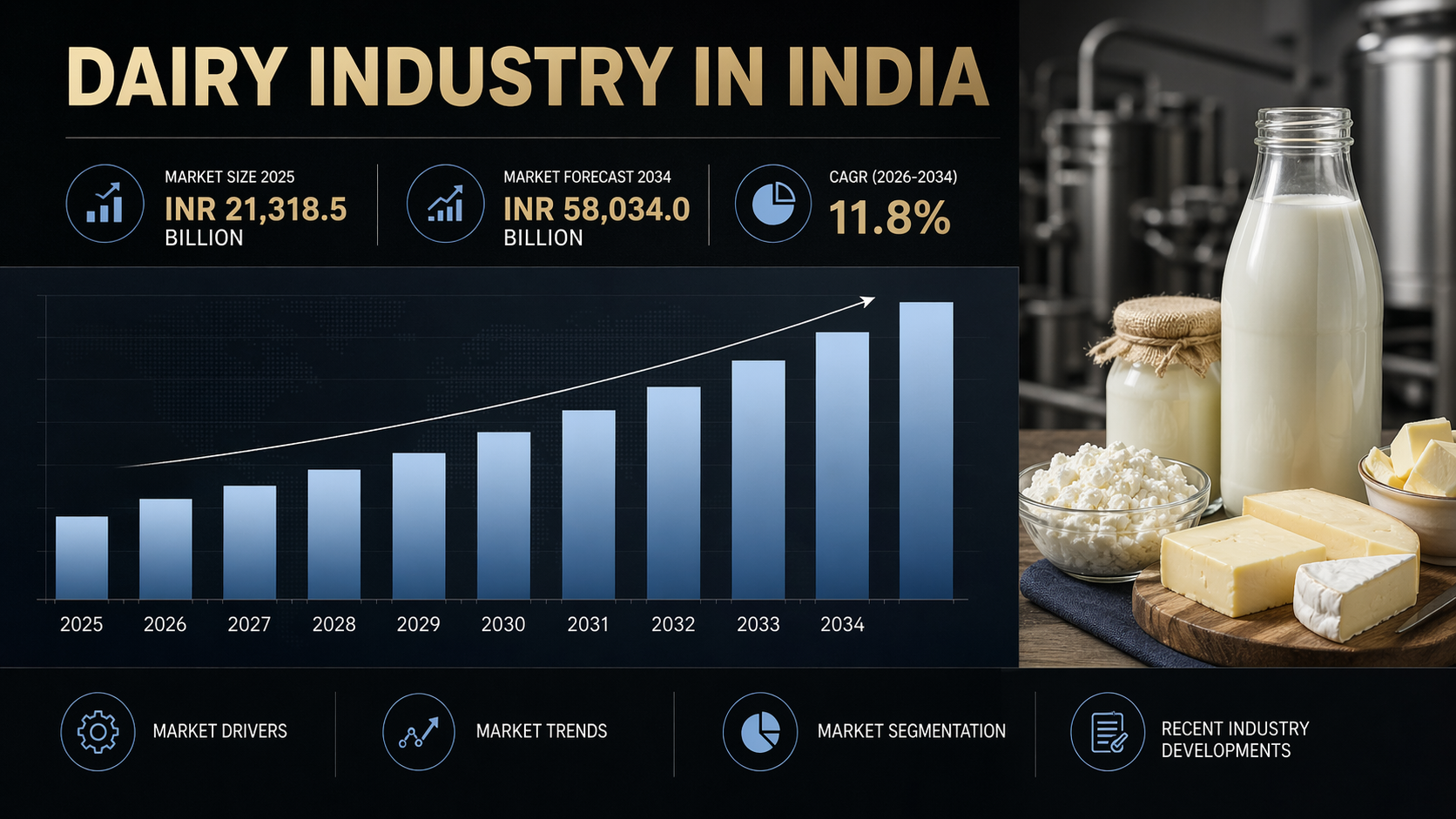
The dairy industry in India was valued at INR 21,318.5 Billion in 2025 and is projected to reach INR 58,034.0 Billion by 2034, registering a robust CAGR of 11.8% during 2026-2034.
As detailed in the Dairy Industry In India: Industry Overview, Consumption Trends & Report 2026–2034, India’s dairy sector is undergoing a profound structural transformation, evolving from fragmented procurement networks into a highly organized, tech-enabled agricultural powerhouse. This evolution presents massive, high-yield opportunities for supply chain investors, agritech innovators, and FMCG conglomerates looking to capture a rapidly formalizing market.
- The market valuation stood at a formidable INR 21,318.5 Billion in 2025 and is projected to scale aggressively to INR 58,034.0 Billion by 2034.
- Driven by robust domestic consumption and premiumization, the sector is forecasting an exceptional Compound Annual Growth Rate (CAGR) of 11.8% spanning the 2026–2034 period.
- Liquid milk remains the dominant consumption anchor, commanding a 65.30% market share and acting as the primary revenue stabilizer for processing networks.
- Uttar Pradesh leads the regional production matrix with an 18.70% market share, underpinned by the nation’s largest dairy animal population and deeply integrated cooperative models.
- With milk processing volumes through formal dairies anticipated to surge by 10.3% by 2030, the shift from unorganized channels to FSSAI-compliant branded retail is accelerating unprecedented institutional capital inflows.
➤ Request Sample Report – Evaluate Core Statistics Driving Your Industry Trends
Table of Contents
India’s Strategic Vision for the Dairy Industry In India:
- Securing Global Supply Chain Dominance: Already producing roughly 23% of the world’s milk, India’s strategic mandate focuses on transitioning from pure domestic self-reliance to becoming a formidable export hub, specifically targeting Skimmed Milk Powder (SMP) and value-added dairy exports to the Middle East and Southeast Asia.
- Aggressive Policy and Subsidy Deployment: The central government is heavily subsidizing agricultural modernization through schemes like the Rashtriya Gokul Mission (backed by an INR 3,400 Crore outlay) and the Dairy Entrepreneurship Development Scheme (DEDS), actively de-risking capital expenditures for advanced breeding programs and primary procurement infrastructure.
- Cold-Chain and Infrastructure Formalization: A macro-level governmental priority is mitigating post-harvest losses and seasonal production volatility. Strategic state investments into bulk milk coolers, chilling centers, and automated logistics aim to bridge the rural-urban divide, fully integrating Tier-2 and Tier-3 markets into the organized national dairy grid.
Why Invest in the Dairy Industry In India:Key Growth Drivers & ROI
- Massive Consumption Base in Real Estate: India’s population exceeding 1.5 billion provides an unparalleled, recession-proof consumption base. With per-capita milk availability growing at 3.1% annually, institutional buyers and HoReCa (Hotel, Restaurant, Café) segments guarantee predictable, high-volume offtake for organized dairy processors, ensuring consistent B2B revenue streams.
- Aggressive Policy Support and Subsidies: Institutional investors benefit from aggressive government-backed cooperative modernization and structural subsidies. National Dairy Development Board initiatives provide a secure operational framework, significantly lowering localized procurement costs and mitigating seasonal fodder volatility for both private and cooperative market entrants across the supply chain.
- Premiumization Through Tech Upgrades: The rapid urban shift towards clean-label, high-protein nutrition is driving explosive demand for premium A2 and organic dairy, which is growing at roughly 20% annually. This premiumization allows fast-moving consumer goods (FMCG) brands to capture lucrative margins far exceeding traditional, commoditized liquid milk.
- Supply Chain Consolidation and Efficiencies: The integration of quick-commerce logistics is revolutionizing short-shelf-life distribution. B2B investments in digital supply chain traceability, automated milking systems (AMS), and optimized cold-chain networks are systematically reducing operational friction, minimizing post-harvest losses, and vastly improving farm-to-retail yield structures for institutional operators.
Dairy Industry In India Market Trends & Future Outlook:
- Rise of Probiotic and Functional Dairy: The market is witnessing a structural shift toward immunity-focused, gut-health, and fortified value-added products. Though currently a niche, functional dairy offers hyper-growth potential as urban health consciousness accelerates B2B product innovation and expands retail margins.
- Agri-Tech and IoT-Enabled Farm Management: The future of primary production relies heavily on data. Automated Milking Systems (AMS), blockchain-based traceability, and AI-driven processing optimizations are rapidly deploying across progressive farms, lowering labor dependencies, and ensuring stringent compliance with export-grade quality standards.
- Quick-Commerce Reshaping Retail Distribution: The 10-to-15-minute delivery model has successfully cracked the complex cold-chain logistics of short-shelf-life dairy. This disruption is aggressively shifting market share from local unorganized vendors to branded, organized retail in major metropolitan and expanding Tier-2 regions.
- Emergence of Next-Gen Processing Technologies: Precision fermentation and advanced ultra-high-temperature (UHT) processing are extending shelf life without compromising nutritional integrity. This capability enables processors to penetrate deeply into remote, low-infrastructure rural markets while minimizing inventory spoilage and localized logistics risks.
➤ Request Full Brochure – Discover the Complete TOC and Data Coverage
By the IMARC Group, the Top Competitive Landscape & their Positioning:
- GCMMF
- Mother Dairy Fruits & Vegetables Pvt. Limited
- Nestlé S.A. (India)
- Parag Milk Foods Ltd.
- Heritage Foods Ltd.
- Hatsun Agro Product Ltd.
- Karnataka Co-operative Milk Producers Federation Ltd.
- Tirumala Milk Products Pvt. Ltd.
- COMFED Bihar Sudha
- Prabhat Dairy (Sunfresh Agro Industries Pvt. Ltd.)
Covering an in-depth analysis of the competitive landscape, market structure, key player positioning, competitive dashboards, top winning strategies, and detailed profiles of all major industry participants you will gain access to all these exclusive insights within the full research report.
Market Segmentation Breakdown:
Analysis by Product Type:
- Liquid Milk (Dominant segment; essential staple)
- A2 Milk (Fastest growing niche)
- UHT Milk
- Organic Milk
- Flavored Milk & Yoghurts
- Cheese & Butter
- Ghee (Traditional staple with high value)
- Ice Cream
- Dairy Sweets
- Others (Paneer, Khoya, Skimmed Milk Powder)
Liquid milk dominates the India dairy product market with an overwhelming 65.30% share in 2025
Regional Insights:
- Uttar Pradesh: The largest market, supported by a vast network of cooperatives and high buffalo population.
- Rajasthan & Gujarat: Key milk-surplus states with strong cooperative structures (e.g., Amul in Gujarat).
- Delhi-NCR: Rapidly growing urban market driving demand for premium and packaged dairy.
- Maharashtra
- Karnataka
- Tamil Nadu
- Others
Uttar Pradesh anchors the dairy industry in India with the largest single-state share of 18.70% in 2025.
Recent News & Developments
- A2 Milk Expansion: Parag Milk Foods is scaling premium A2 milk and organic dairy portfolios targeting urban consumers.
- Cooperative Strengthening: National Dairy Development Board continues to modernize village-level procurement and cold-chain infrastructure.
- Global FMCG Push: Nestlé India is expanding its dairy-based nutrition and value-added product offerings.
- Private Sector Capacity Expansion: Hatsun Agro Product is investing in new processing plants to boost cheese and ice cream production.
- Amul Market Leadership: GCMMF continues to dominate through extensive cooperative networks and aggressive product diversification.
Note: If you need specific information that is not currently within the scope of the report, we can provide it to you as a part of the customization.
➤ Request Customization – Align the Report Insights with Your Strategic Goals
Frequently Asked Questions (FAQs):
Q1. What is transforming the traditional dairy industry into a high-growth FMCG sector?
The shift toward value-added products like probiotics, flavored milk, and organic dairy is converting the industry from a commodity-based model into a high-margin FMCG ecosystem.
Q2. Why is A2 and organic milk gaining strong traction in India?
Health-conscious urban consumers are increasingly preferring A2 and organic variants due to perceived digestive benefits, clean-label sourcing, and premium quality assurance.
Q3. How are cooperatives shaping the Indian dairy ecosystem?
Organizations like Gujarat Cooperative Milk Marketing Federation have built scalable procurement networks, ensuring stable farmer incomes and consistent raw milk supply.
Q4. What role does technology play in modern dairy supply chains?
AI, IoT-based herd monitoring, and blockchain traceability are enhancing quality control, reducing spoilage, and improving supply chain transparency across fragmented rural networks.
Q5. Which regions dominate milk production and consumption in India?
Uttar Pradesh leads production due to its large livestock base, while urban hubs like Delhi NCR are driving demand for premium dairy products.
Strategic Insight & Verdict
From a strategic perspective, the India dairy industry is rapidly transitioning into a high-value, technology-integrated FMCG powerhouse, where leading players such as GCMMF, Mother Dairy, and Nestlé India are aggressively expanding value-added portfolios to capture premium urban demand. Simultaneously, companies like Parag Milk Foods and Hatsun Agro Product are investing in advanced processing and cold-chain infrastructure to scale high-margin categories such as cheese, whey protein, and A2 milk. Backed by strong policy support from National Dairy Development Board and increasing digital supply chain integration, the sector is evolving toward a more organized, traceable, and export-oriented ecosystem. Investors focusing on premiumization, value-added processing, and tech-enabled procurement networks are best positioned to unlock sustained, high-growth returns in this structurally expanding market.
Tarang, Digital Insights Specialist at IMARC Group: https://www.linkedin.com/in/tarang-chauhan-31a82b265/
Verified Data Source: IMARC Group
Contact Us:
IMARC Group
134 N 4th St. Brooklyn, NY 11249, USA
Email: sales@imarcgroup.com
Tel No:(D) +91 120 433 0800
United States: +1-202071-6302
