
Market Outlook
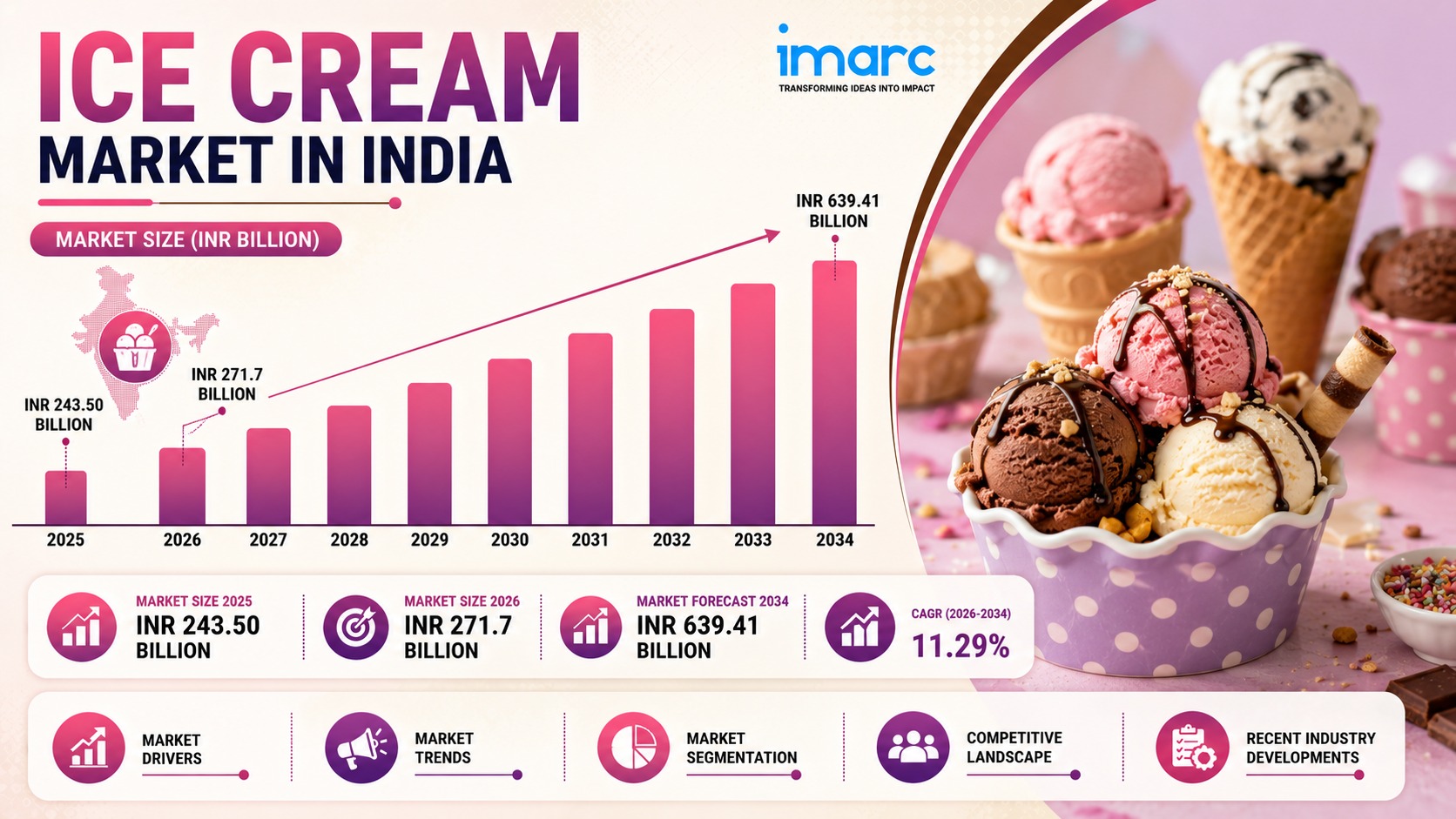
The ice cream market in India was valued at INR 243.50 Billion in 2025 and is estimated to reach INR 271.7 Billion in 2026. The market is further projected to grow INR 639.41 Billion by 2034, exhibiting at a CAGR of 11.29% during 2026-2034. The market expansion is underpinned by rising disposable incomes and rapid urbanisation driving demand for indulgent and premium frozen desserts, expanding quick-commerce and cold-chain infrastructure improving year-round product accessibility, and growing consumer preference for convenient, single-serve, on-the-go formats. Rising per capita consumption, premiumisation across flavours and formats, and the expansion of organised retail and foodservice channels necessitate continuous product innovation, while digital delivery platforms and last-mile cold-chain logistics enhance operational reach across the country.
Improving cold-chain connectivity and rising incomes across tier-two and tier-three cities further stimulate demand for branded and packaged ice cream, collectively expanding the overall India ice cream market share. The industry demonstrates strong resilience amid seasonal fluctuations, benefiting from a gradual shift toward year-round consumption occasions, rising demand for premium and functional formulations, and deeper penetration of organised retail and quick-commerce channels across metro as well as tier-two and tier-three cities.
Market Snapshot:
- Market Size (2025): INR 243.50 Billion
- Estimated Market Size (2026): INR 271.7 Billion
- Forecast Market Size (2034): INR 639.41 Billion
- CAGR: 29% (2026-2034)
- Leading Segment by Type: Impulse Ice Cream (60.60% share)
- Leading Segment by Format: Cones (27.30% share)
- Leading Region: Maharashtra (15.90% share)
What are the Growth Factors of the Ice Cream Market in India?
- India’s Vast and Growing Dairy Raw-Material Base
India remains the world’s largest milk producer, with output rising nearly 4% annually to 239.30 million tonnes in 2023-24, up from 146.31 million tonnes in 2014-15 a compound annual growth rate of about 5.62% over the decade. Per-capita milk availability has climbed to 471 grams per day in 2023-24, well above the global average of around 322 grams per day. This abundant and steadily growing dairy base gives domestic ice cream manufacturers reliable access to their principal raw material, supporting continuous capacity expansion without significant import dependence.
- Large-Scale Corporate Capacity Investment
Leading players are committing substantial capital to scale manufacturing. Lotte Wellfood, parent of Havmor Ice Cream India, has invested Rs. 500 crore in a new Pune facility with an annual capacity of 50 million litres, expandable to 100 million litres, and has outlined a further USD 300 million (~Rs. 2,500 crore) investment plan over the next three to five years. Vadilal Industries posted consolidated revenue of Rs. 1,011.33 crore in FY25, up from Rs. 912.57 crore in FY24, while continuing to expand its dealer network, which now exceeds 1,50,000 outlets.
- Government-Backed Cold Chain and Food-Processing Infrastructure
The Ministry of Food Processing Industries implements the Pradhan Mantri Kisan SAMPADA Yojana (PMKSY), under which the Integrated Cold Chain and Value Addition Infrastructure Scheme supports the creation of cold storage, refrigerated transport and temperature-controlled distribution networks connecting the farm gate to the retail outlet. The scheme has been approved for continuation with an allocation of Rs. 4,600 crore till 31 March 2026, coterminous with the 15th Finance Commission cycle. This infrastructure directly benefits temperature-sensitive categories such as ice cream, where an unbroken cold chain is essential to product quality and shelf life.
- Expansion of Organised Retail, E-commerce and Quick Commerce
The growing reach of organised retail and quick-commerce platforms such as Zepto, Swiggy Instamart and Blinkit has made ice cream more accessible throughout the year and across a wider geography. This shift is enabling brands to reduce their historical dependence on seasonal, footfall-driven sales through traditional general trade, while also supporting the introduction of a wider range of formats, from affordable impulse packs to premium tubs, tailored to online buying patterns.
➤ Grab a sample copy of this report: https://www.imarcgroup.com/ice-cream-market-india/requestsample
What Are the Key Trends Shaping the Market?
- Corporate Restructuring Toward Focused, Pure-Play Ice Cream Entities
Hindustan Unilever’s demerger of Kwality Wall’s, Cornetto, Magnum, Feast and Creamy Delight into the standalone Kwality Wall’s (India) Limited became effective on 1 December 2025, following National Company Law Tribunal approval on 30 October 2025. The move reflects a broader industry trend of separating high-growth ice cream businesses from diversified FMCG portfolios to give them dedicated management focus and capital allocation, with the entity set to be majority owned (61.9%) by The Magnum Ice Cream Company on listing.
- Entry of Global Manufacturing Capacity and Technology
International players continue to deepen their India manufacturing footprint. Lotte Wellfood’s new Pune plant, built with Korean process technology following the 2024 merger of Lotte India and Havmor Ice Cream, is designed to extend distribution from western India into south and central Indian markets.
- Rising Scale-Up by Domestic Dairy Cooperatives and Private Players
The overall Amul brand crossed Rs. 1 lakh crore in unduplicated turnover in FY26, up 11% over FY25, with GCMMF’s own topline at around Rs. 66,000 crore in FY25. Mother Dairy’s ice cream business crossed Rs. 500 crore in FY24 and was targeted to reach Rs. 650-700 crore in the following summer season, while Cream Bell, owned by Devyani Food Industries (RJ Corp), reported annual revenue of Rs. 1,110 crore as of March 2025 underscoring the pace of scale-up across both cooperative and private organised players.
- Dual-Track Premiumisation and Value-Format Expansion
Manufacturers are simultaneously expanding at both ends of the price spectrum: introducing low-priced, single-serve formats to widen access in smaller towns and villages, while also building premium, ingredient-led tubs and artisanal formats for urban, higher-income consumers. This dual-track approach mirrors the broader premiumisation-cum-mass-reach strategy playing out across India’s packaged food and dairy sector.
What Are the Major Market Challenges?
- High Perishability and Cold-Chain Dependence
Ice cream’s dependence on an unbroken cold chain from factory to retail point makes distribution costly and logistically demanding, particularly in tier-two, tier-three and rural markets where refrigerated storage and transport remain less developed. Any break in the cold chain directly affects product quality, making consistent temperature control a persistent operating challenge for manufacturers and distributors alike.
- Strong Seasonal Concentration of Demand
Despite growing efforts to position ice cream as a year-round treat, sales remain heavily concentrated in the summer months, creating pronounced swings in capacity utilisation, working-capital needs and quarterly earnings. Vadilal Dairy International’s own results illustrate this pattern, with net profit of Rs. 127.77 crore in the peak summer quarter ended June 2026 compared with a net profit of just Rs. 27.40 crore in the preceding quarter ended March 2026 a swing that highlights how heavily manufacturer earnings still depend on the summer selling season.
- Continued Price Competition from the Unorganised Segment
A large base of local vendors, small-scale manufacturers and traditional kulfi sellers continues to compete primarily on price, particularly across rural and semi-urban markets, and often operates with limited refrigeration and inconsistent quality standards. This ongoing price competition constrains the pace at which organised, branded players can consolidate volumes, even as consumer preference gradually shifts toward hygienic, packaged products.
➤ Explore the Full Report with Charts, Table of Contents, and List of Figures: https://www.imarcgroup.com/ice-cream-market-india
How Is the Market Segmented? (From the given Link)
- By Type: Impulse Ice Cream dominates the market with a share of 60.60% in 2025, driven by strong demand for convenient, single-serve formats such as cones, cups, sticks and bars, supported by affordability and wide availability through retail stores, kiosks and quick-commerce platforms. Other key segments include Take-Home Ice Cream and Artisanal Ice Cream.
- By Format: Cones lead with a 27.30% share in 2025, owing to their convenience, portability and strong appeal as an on-the-go dessert format. Sticks, Bricks, Cups and other formats such as sundaes and tubs account for the remainder.
- By Distribution Channel: General Trade continues to anchor overall volumes, while Supermarkets/Hypermarkets, Ice Cream Parlors, Convenience Stores and Online/quick-commerce channels are the fastest-expanding routes to market.
- Regional Insights: Maharashtra dominates with a 15.90% India Ice Cream Market Share in 2025, supported by its large urban population, high disposable incomes and strong retail presence in cities such as Mumbai and Pune. Uttar Pradesh (9.50%), Karnataka (7.90%), Gujarat (7.60%) and Andhra Pradesh & Telangana (7.10%) represent the other leading regional markets.
Competitive Landscape:
The India ice cream market exhibits a mix of large dairy cooperatives, multinational-backed entities and homegrown private players, with competition driven by product innovation, flavour diversification, pricing and distribution reach.
GCMMF (Amul) remains India’s largest dairy cooperative, with the overall Amul brand crossing Rs. 1 lakh crore in unduplicated turnover in FY26, up 11% over FY25, while GCMMF’s own topline stood at around Rs. 66,000 crore in FY25.
The Magnum Ice Cream Company, through the newly demerged Kwality Wall’s (India) Limited, holds the Kwality Wall’s, Cornetto, Magnum, Feast and Creamy Delight brands, with the ice cream business having generated approximately Rs. 1,783-1,800 crore in FY25 revenue prior to the split.
Vadilal Group reported consolidated revenue of Rs. 1,011.33 crore in FY25 and states it holds a 16% share of the organised Indian ice cream market.
LOTTE (Havmor) is targeting revenue of around Rs. 3,000 crore by FY27, up from roughly Rs. 1,750 crore in CY2024, following its 2024 merger and fresh Pune capacity.
Other established players include Mother Dairy, Cream Bell, Dinshaw’s Dairy Foods, Baskin Robbins and Natural Ice Cream, alongside regional cooperative brands such as Assam’s Purabi Dairy.
Recent News or Developments:
- HUL completes Kwality Wall’s demerger (December 2025): Hindustan Unilever’s demerger of its ice cream business into the standalone, separately listed Kwality Wall’s (India) Limited became effective on 1 December 2025, following NCLT approval on 30 October 2025, with The Magnum Ice Cream Company set to hold a 61.9% stake, and listing expected within Q4 FY26.
- Lotte Wellfood inaugurates Rs. 500 crore Pune ice cream plant (2026): Lotte Wellfood inaugurated one of its largest ice cream manufacturing facilities in India at Pune, with an annual production capacity of 50 million litres, expandable to 100 million litres, and announced plans for a further USD 300 million investment in capacity and supply chain over the next three to five years.
- Assam’s Purabi Dairy exports ice cream to Bhutan (2026): North East Dairy and Foods Limited, which markets Purabi Dairy ice cream manufactured by the West Assam Milk Producers’ Cooperative Union, flagged off its first international consignment of 5,627 litres of ice cream to Bhutan, facilitated by the Agricultural and Processed Food Products Export Development Authority (APEDA) under the Ministry of Commerce and Industry.
Customization Note: If you require any specific information not covered within this report’s scope, we will provide it as part of the customization.
➤ Request Report Customization: https://www.imarcgroup.com/request?type=report&id=777&flag=E
Frequently Asked Questions (FAQ)
Q1. What is the size of the India Ice Cream Market?
The India ice cream market size was valued at INR 243.50 Billion in 2025.
Q2. What is the projected growth rate?
The market is projected to grow at a compound annual growth rate of 11.29% from 2026-2034, reaching INR 639.41 Billion by 2034.
Q3. What are the key drivers?
Key drivers include India’s vast dairy raw-material base, large-scale corporate capacity investment, government-backed cold-chain infrastructure, and the expansion of organised retail and quick commerce.
Q4. Which region holds the leading position?
Maharashtra represents the largest segment, accounting for a 15.90% India Ice Cream Market Share in 2025.
Q5. Which segment dominates the market by type?
Impulse Ice Cream constitutes the cornerstone of the market, holding a 60.60% share in 2025.
