
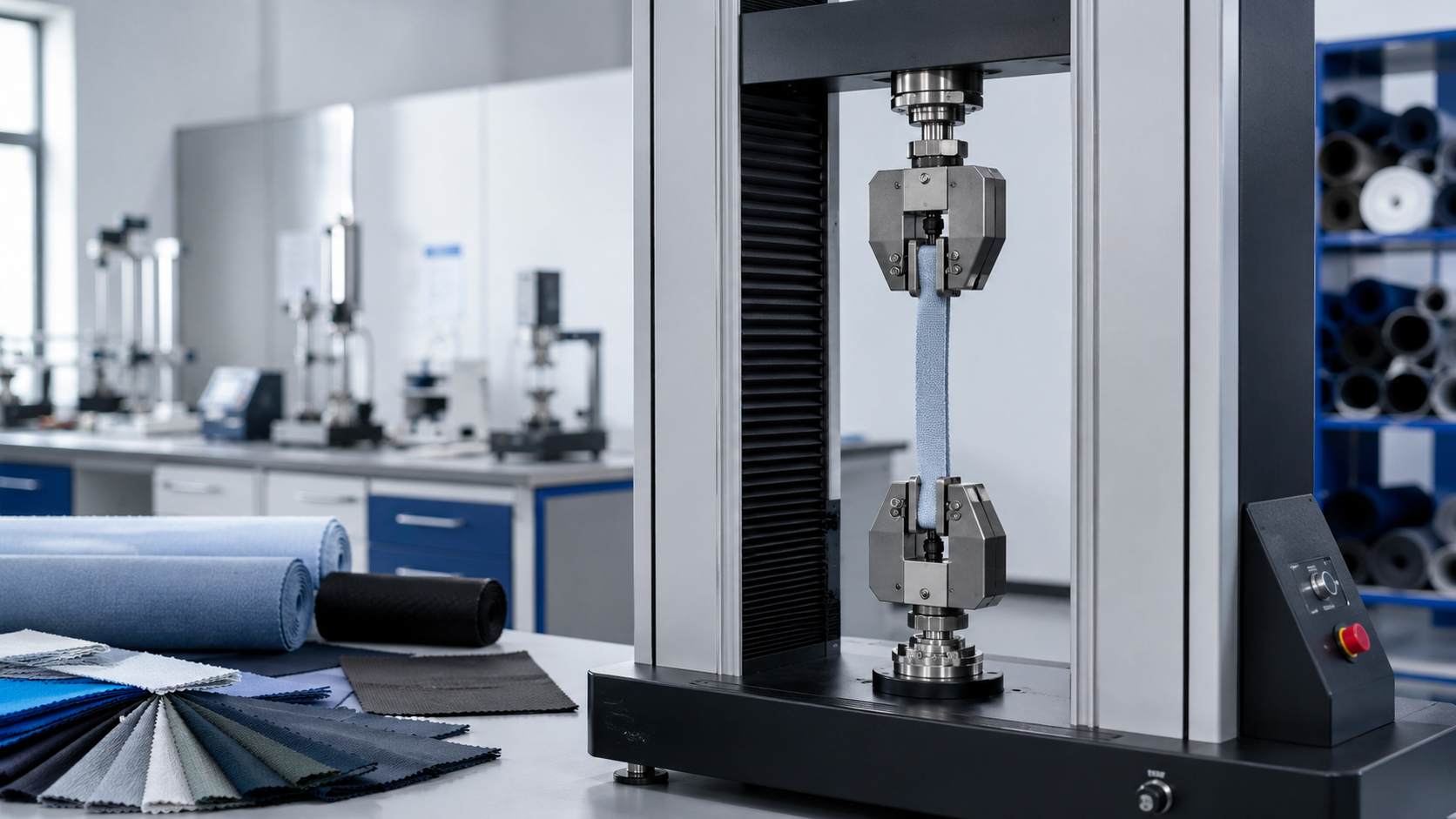
SUMMARY: A Tensile Testing machine is a material testing instrument that pulls a specimen until it stretches, yields, or breaks to measure tensile strength, elongation, breaking force, and related mechanical properties. It is widely used in textile, yarn, plastic, packaging, wire, leather, and R&D laboratories where repeatable strength data supports quality control and product development. ISO 13934-1 defines tensile testing for textile fabrics by measuring maximum force and elongation at maximum force using the strip method.
Table of Contents
Table of Contents
- What is a Tensile Testing machine?
- How does a tensile testing machine work?
- What does a tensile testing machine measure?
- Where is a tensile testing machine used?
- Tensile testing machine vs universal testing machine
- Which standards matter for tensile testing?
- What are the benefits of tensile testing?
- How to choose the right tensile testing machine
- Why choose Apple Electroniks?
- Suggested internal links
- FAQs
What is a Tensile Testing machine?
A Tensile Testing machine is a testing instrument that pulls a material sample in opposite directions to measure how much force it can withstand before stretching, yielding, or breaking. It helps laboratories calculate tensile strength, elongation, breaking load, yield load, and force-extension behavior under controlled test conditions.
In simple terms, tensile testing shows how strong and stretchable a material is. For textile and yarn manufacturers, this is important because fabric, fiber, thread, straps, nonwovens, and technical textiles must perform consistently during processing and final use.
A tensile testing machine typically includes a load frame, load cell, grips, moving crosshead, motor drive, control system, and testing software. The specimen is clamped between two grips, and the machine applies a controlled pulling force until the sample reaches a defined extension or breaks.
For textile fabrics, ISO 13934-1:2013 specifies a procedure to determine maximum force and elongation at maximum force using the strip method. For plastics, ASTM D638 covers tensile properties of unreinforced and reinforced plastics up to 14 mm thickness, while films below 1.0 mm are directed to ASTM D882.
How does a tensile testing machine work?
A tensile testing machine works by holding a prepared specimen between two grips, moving one grip at a controlled speed, and recording the force and extension throughout the test. The machine converts this data into results such as breaking load, elongation percentage, tensile strength, and stress-strain behavior.
The working process usually follows these steps:
- Prepare the specimen according to the relevant standard, such as strip, grab, yarn, dogbone, strap, or film format.
- Select the correct load cell based on the expected breaking force.
- Fix the specimen in the grips without slippage, twisting, or pre-damage.
- Set the test speed, gauge length, and method in the software or control panel.
- Start the test so the crosshead pulls the specimen at a controlled rate.
- Record force and extension data until the sample breaks or reaches a target elongation.
- Export the report with breaking force, elongation, peak load, yield point, and graph.
Constant Rate of Extension, also called CRE, is common in textile tensile testing because the moving crosshead extends the specimen at a controlled rate. ASTM D76 covers three types of textile tensile testing machines: CRE, Constant Rate of Traverse, and Constant Rate of Loading.
Apple Electroniks’ UTM 5K Universal Testing Machine uses CRE operation, supports touch and PC control, and offers speed settings from 0.1 mm/min to 1000 mm/min with better than ±1% speed accuracy.
What does a tensile testing machine measure?
A tensile testing machine measures how a material behaves under pulling force, especially its maximum load, elongation, yield point, break point, and force-extension curve. These values help manufacturers compare raw materials, validate production batches, detect weak materials, and document product quality with repeatable test data.
Common tensile testing results include:
| Measurement | What it means | Why it matters |
|---|---|---|
| Breaking force | Maximum force before the sample breaks | Shows the load-bearing capacity of fabric, yarn, strap, wire, or film |
| Tensile strength | Force per unit area before failure | Helps compare material strength across batches |
| Elongation at break | Percentage stretch before rupture | Shows flexibility and stretch performance |
| Yield load | Force where permanent deformation begins | Important for plastics, polymers, and flexible materials |
| Force-extension graph | Full curve of force vs extension | Helps analyze material behavior visually |
| CV% | Coefficient of variation across samples | Shows consistency between multiple test specimens |
Apple Electroniks’ UTM 5K software displays force-extension graphs, breaking load, elongation, yield load, yield elongation, and CV%, helping labs analyze multiple test results in one workflow.
For textile testing, ISO 13934-1 focuses on two core values: maximum force and elongation at maximum force. For plastics, ASTM D638 states that tensile properties vary with specimen preparation, testing speed, and test environment, so these factors must be controlled for reliable comparison.
Where is a tensile testing machine used?
A tensile testing machine is used wherever manufacturers need to verify material strength, stretch, durability, or batch consistency. It is common in textile mills, yarn plants, garment testing labs, packaging companies, polymer labs, wire and cable units, leather testing labs, automotive material labs, and research institutions.
Key industries include:
- Textile and fabric: woven fabric, knitted fabric, technical textile, nonwoven fabric
- Fiber and yarn: single yarn strength, lea yarn strength, fiber elongation
- Packaging and film: plastic film, flexible packaging, laminated sheets
- Wire and electrical: crimp pull force, terminal strength, cable-related pull tests
- Leather and footwear: seam strength, tear behavior, strap strength
- Automotive materials: coated fabric, trims, belts, webbing, technical materials
- R&D laboratories: comparative material development and validation
Apple Electroniks provides testing solutions for textile, polymer, wire, electrical, coating, adhesion, flammability, shrinkage, weathering, fiber, fabric, and yarn applications. Its fiber and yarn industry page specifically lists tenacity, elongation, tensile strength, shrinkage, dimensional stability, and durability as important testing areas for fiber and yarn manufacturers.
The material testing market was projected at USD 871.9 million in 2025 and is expected to reach USD 1,070.9 million by 2030, growing at a 4.2% CAGR, according to MarketsandMarkets.
Tensile testing machine vs universal testing machine: What is the difference?
A tensile testing machine is mainly used for pulling tests, while a universal testing machine can perform tensile, compression, peel, tear, flex, puncture, friction, and other force-based tests with suitable fixtures. In many laboratories, a universal testing machine is used as a tensile tester when fitted with tensile grips.
| Factor | Tensile Testing Machine | Universal Testing Machine |
|---|---|---|
| Main purpose | Pulling materials until extension or break | Multiple mechanical tests using different fixtures |
| Common tests | Tensile strength, elongation, breaking load | Tensile, compression, peel, tear, flex, puncture, shear |
| Best for | Labs focused mainly on tensile testing | Labs needing multi-application testing |
| Fixtures | Tensile grips, yarn grips, fabric grips | Tensile grips plus compression, peel, tear, flex fixtures |
| Software output | Force-extension and tensile results | Multiple test method reports |
| Buying decision | Choose when tensile testing is the priority | Choose when one machine must cover several tests |
Instron describes universal testing machines as systems that can perform tensile, compression, flex, peel, puncture, friction, shear, and other tests depending on fixtures and configuration.
Apple Electroniks’ UTM 5K supports eleven standard test functions, including tensile, peeling, tearing, seam slippage, bursting, elastic recovery, single yarn, and lea yarn tests. This makes it suitable for textile, yarn, strap, and flexible material laboratories that want tensile testing plus additional strength evaluation from one machine.
Which standards matter for tensile testing?
Tensile testing standards define specimen shape, gauge length, speed, gripping method, calculation method, and reporting format. The right standard depends on the material being tested, such as textile fabric, yarn, plastic, film, rubber, wire, leather, or technical material.
Important standards and references include:
- ISO 13934-1: Textile fabric tensile properties by strip method.
- ASTM D638: Tensile properties of rigid and semi-rigid plastics.
- ASTM D882: Tensile properties of thin plastic sheeting and films below 1.0 mm thickness.
- ASTM D76: Operating characteristics of tensile testing machines for textiles.
- ASTM E4: Force calibration and verification of testing machines.
- ISO 7500-1: Calibration and verification of tension/compression testing machines.
ISO 7500-1 specifies calibration and verification of tension/compression testing machines, including general inspection, force-measuring system calibration, and confirmation that the machine meets performance limits for a specified class.
ASTM E4 covers force calibration and verification for static or quasi-static tension and compression testing machines. ASTM E4 also states that force indication verification supports traceability to SI when the verification devices have known force characteristics and are calibrated according to ASTM E74.
What are the benefits of tensile testing?
Tensile testing helps manufacturers make better quality decisions by turning material strength into measurable data. It reduces guesswork, supports supplier comparison, helps detect weak batches, improves product development, and provides documented evidence for internal quality control or customer approval.
Main benefits include:
- Improved quality control: Identify weak fabric, yarn, film, wire, or strap before production use.
- Better supplier comparison: Compare tensile strength and elongation across vendors.
- Reduced product failure risk: Detect low-strength batches before dispatch.
- Faster R&D decisions: Compare material formulations, coatings, blends, or constructions.
- Standardized reporting: Produce test reports with graphs, values, and repeatability data.
- Lower manual error: Software-based reports reduce handwritten calculation mistakes.
In plastics, ASTM D638 notes that tensile property data is useful for control, specification, qualitative characterization, and R&D. In textiles, ISO 13934-1 provides a defined method to determine maximum force and elongation at maximum force, which helps compare fabric performance using a standardized approach.
For production labs, the biggest practical benefit is repeatability. Apple Electroniks’ UTM 5K offers 0.01 mm displacement resolution and ±0.5% indicated load measurement accuracy, supporting consistent measurement quality for textile, yarn, and strap testing.
How do you choose the right tensile testing machine?
Choose a tensile testing machine by matching the machine capacity, accuracy, grips, speed range, software, standards, and material type to your actual test requirements. The best machine is not always the highest-capacity model; it is the one that gives accurate results within your normal working force range.
Use this buying checklist:
- Material type: Decide whether you test fabric, yarn, fiber, straps, films, plastic, leather, wire, or mixed materials.
- Force capacity: Select a load cell that matches expected breaking force.
- Accuracy: Check force accuracy, displacement resolution, and speed accuracy.
- Grips and fixtures: Choose jaws that prevent slippage and damage.
- Test standards: Confirm support for ISO, ASTM, or buyer-specific methods.
- Software: Look for real-time graphing, CV%, report export, and data storage.
- Speed range: Ensure the machine covers required test speeds.
- Service support: Prefer suppliers that offer installation, calibration support, training, and spare parts.
- Future expansion: Choose a UTM if your lab may later need peel, tear, compression, or flex testing.
For example, Apple Electroniks’ UTM 5K provides 5 kN capacity, CRE operation, dual touch and PC control, and a speed range from 0.1 mm/min to 1000 mm/min. For plastics, ASTM D638 applies up to 14 mm thickness, while thin plastic films under 1.0 mm should use ASTM D882, so buyers testing multiple materials must confirm method compatibility before purchase.
Why choose Apple Electroniks for tensile testing equipment?
Apple Electroniks is a suitable choice for tensile testing equipment when a laboratory needs textile, yarn, strap, fiber, and flexible material testing support from an Indian testing machine manufacturer. The brand offers precision testing instruments for industrial quality control, material testing, automation, and laboratory applications.
Apple Electroniks manufactures and supplies equipment for textile, fiber, flammability, adhesion, shrinkage, weathering, air permeability, surface abrasion, wire, electrical, and material testing applications. Its UTM 5K Universal Testing Machine is designed for textiles, yarns, straps, and flexible materials, with support for tensile, peeling, tearing, seam slippage, bursting, elastic recovery, single yarn strength, and lea yarn strength tests.
For textile and yarn manufacturers, this matters because one machine can cover multiple routine strength tests instead of requiring separate instruments for every application. Apple Electroniks also positions its fiber and yarn testing solutions for natural fibers, synthetic fibers, filament yarns, spun yarns, technical yarns, and related textile materials.
When evaluating a tensile testing machine, request the correct load cell capacity, suitable grips, compatible test methods, calibration support, software features, and sample report format before purchase.
Suggested internal links for topical authority
Use these internal links to build a strong Apple Electroniks testing equipment content cluster:
- Fiber, Fabric & Yarn Testing Equipment → target page for textile, yarn, fiber, tenacity, elongation, and tensile testing products.
- Universal Testing Machine 5KN → target product page for UTM 5K specifications and enquiry intent.
- Wire Testing Machine Guide → related article for wire crimp pull force and electrical component testing.
- Peel Strength Tester Guide → related article for adhesion, peel force, and bond strength testing.
- Fabric Shrinkage Tester Guide → related article for dimensional stability testing.
- Flammability Testing Equipment Guide → related safety and compliance testing cluster.
- Air Permeability Tester Guide → related textile performance testing cluster.
FAQs
What is a tensile testing machine used for?
A tensile testing machine is used to measure how much pulling force a material can withstand before stretching, yielding, or breaking. It is commonly used for textiles, yarn, fiber, plastic, film, wire, leather, straps, and packaging materials.
What is the difference between tensile strength and elongation?
Tensile strength measures how much force a material can resist before failure, while elongation measures how much the material stretches before or at break. Both values are important because a material can be strong, stretchable, brittle, or flexible depending on its application.
Which tensile testing machine is best for textile and yarn testing?
For textile and yarn testing, a CRE-based universal testing machine with suitable fabric grips, yarn grips, accurate load cells, and reporting software is usually preferred. Apple Electroniks’ UTM 5K is designed for textiles, yarns, straps, and flexible materials with 5 kN capacity and multiple test functions.
What standards are used for tensile testing?
Common tensile testing standards include ISO 13934-1 for textile fabrics, ASTM D638 for plastics, ASTM D882 for thin plastic films, ASTM D76 for textile tensile testing machines, ASTM E4 for force verification, and ISO 7500-1 for machine calibration and verification.
What capacity tensile testing machine should I buy?
The right capacity depends on the expected breaking force of your samples. Textile fabrics may use lower-capacity load cells, while straps, webbing, industrial textiles, and technical materials may need higher capacity such as 5 kN or more.
Can one machine test fabric, yarn, straps, and plastic?
Yes, a universal testing machine can test multiple materials when fitted with the correct grips, fixtures, load cell, and test method. Apple Electroniks’ UTM 5K supports textile and yarn tests and can also test plastics with an optional dogbone sample fixture.
Why is calibration important in tensile testing?
Calibration is important because tensile test results depend on accurate force and displacement measurement. ISO 7500-1 specifies calibration and verification of tension/compression testing machines, while ASTM E4 covers force verification practices for testing machines.
