
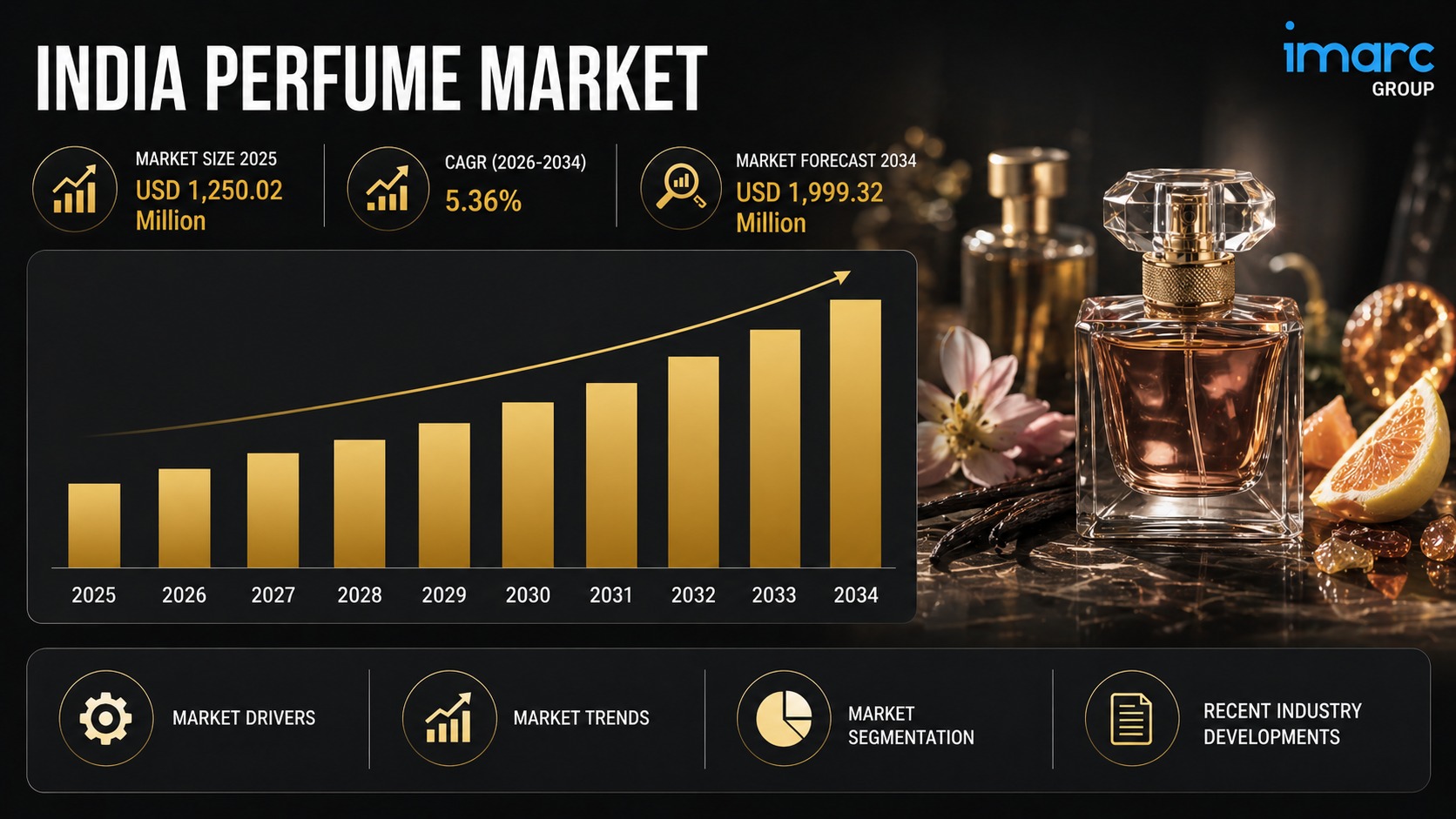
According to IMARC Group’s report titled “India Perfume Market Size, Share, Trends and Forecast by Perfume Type, End User, and Region, 2026-2034“, the report offers a comprehensive analysis of the industry, including India market analysis, trends, share, and regional insights.
The perfume market size in india was valued at USD 1,250.02 Million in 2025 and is projected to reach USD 1,999.32 Million by 2034, growing at a compound annual growth rate of 5.36% from 2026-2034.
India’s perfume market is transitioning from an occasion-driven purchase category to an everyday personal care essential powered by rising disposable incomes, premiumization, and a digital retail revolution that is bringing luxury fragrances within reach of consumers well beyond metro markets. Here is what investors need to know:
- Market valued at USD 1,250.02 Million in 2025, projected to reach USD 1,999.32 Million by 2034 at a CAGR of 5.36%.
- Premium segment dominates at 58%, driven by rising brand consciousness, gifting culture, and aspirational consumption among urban millennials.
- Female end-users lead at 52%, with growing financial independence and social media influence shaping sophisticated fragrance purchasing behavior.
- North India commands 31% regional share, anchored by Delhi-NCR’s premium retail infrastructure and high purchasing power.
- India’s private consumption nearly doubled to USD 2.1 Trillion in 2024 directly expanding the discretionary spending base from which fragrance adoption grows.
Table of Contents
The Strategic Market Challenge: Navigating the Perfume Market in India
The most structurally significant challenge is the substantial price sensitivity that limits premium and international brand penetration beyond metropolitan markets. The price differential between mass and premium offerings creates upgrade barriers for aspirational consumers in tier-2 and tier-3 cities while counterfeit products at lower price points further distort competitive dynamics. Additionally, rural and semi-urban markets retain strong preferences for traditional attars and local scents that differ meaningfully from modern perfume formulations, constraining geographic market expansion even as urban demand accelerates.
➤ Access Industry-Focused Insights and Future Forecasts – Request Sample Report
India’s Strategic Vision for the Perfume Market:
- Organized Retail Infrastructure Expansion: Government-supported retail modernization and organized retail growth are improving premium fragrance accessibility beyond metro markets with Nisara’s October 2024 Pacific Mall Delhi store opening reflecting rising regional demand for dedicated fragrance retail experiences.
- E-Commerce Policy and Digital India: Digital infrastructure development is enabling brands like CHANEL which launched on Nykaa’s platform in May 2025, reaching over 40 million customers to access consumers across urban and semi-urban markets simultaneously without proportional physical retail investment.
- Make in India for Cosmetics and Personal Care: Government manufacturing incentives are supporting domestic fragrance production capacity encouraging indigenous brands to invest in premium formulation capabilities and reduce import dependency for finished fragrance products.
- FSSAI and BIS Regulatory Frameworks: Evolving quality and safety standards for cosmetic and personal care products are creating a compliance baseline that protects consumers and rewards manufacturers investing in authentic, ingredient-transparent formulations.
Why Invest in the India Perfume Market: Key Growth Drivers & ROI
- Premiumization Delivering Per-Unit Revenue Expansion: Titan’s Fragrances Division reporting 25–30% surge in online premium perfume sales confirms that Indian consumers are actively trading up not merely entering the category at entry-level price points. For investors, this premiumization dynamic means revenue growth compounds beyond volume expansion, as each upgrade cycle improves average selling price and margin contribution simultaneously.
- International Brand Entry Validating Market Maturity: Diptyque’s December 2024 launch of its first immersive India retail store at Chanakya Mall, New Delhi, and Creed’s 2025 partnership with LUXASIA for omnichannel India expansion signal that global luxury fragrance houses now regard India as a commercially viable premium market not a future consideration. These entry decisions, made by capital-disciplined luxury businesses, provide independent validation of India’s fragrance market investment thesis.
- Digital Commerce Democratizing Premium Access: 55% of prestige beauty brands’ India sales now come from non-metro cities demonstrating that e-commerce is actively closing the geographic access gap that previously concentrated premium fragrance consumption in a handful of metropolitan markets. Brands leveraging influencer marketing as demonstrated by Rare Beauty’s 2025 engagement of Indian creator Ankush Bahuguna for its global fragrance launch are building aspirational awareness among younger demographics at a fraction of traditional media costs.
India Perfume Market Trends & Future Outlook:
- Indigenous attars and natural botanical fragrances are gaining premium positioning, with February 2025 consumer trends confirming renewed appreciation for heritage-based, eco-conscious formulations among urban buyers.
- Omnichannel retail is becoming the standard distribution architecture, with luxury brands simultaneously investing in immersive physical boutiques and premium e-commerce platforms to serve consumers across different purchasing contexts.
- Sustainable and clean-label formulations are reshaping product development priorities, as environmentally conscious consumers increasingly seek transparent ingredient sourcing, cruelty-free certification, and eco-friendly packaging.
- Gifting culture is sustaining occasion-independent demand, with festivals, weddings, and corporate occasions creating recurring premium fragrance purchase cycles that partially offset seasonal demand fluctuations.
➤ Explore the Complete TOC and Data Coverage – Get Full Brochure
Regulatory Landscape & Policy Catalysts in India:
- BIS Cosmetics Quality Standards: Bureau of Indian Standards’ quality frameworks for cosmetic and personal care products are establishing compliance baselines that reward authentic manufacturers and create barriers for counterfeit products that distort premium market pricing.
- E-Commerce Policy Framework: Government-supported e-commerce infrastructure development is enabling brands like CHANEL and Creed to reach over 40 million consumers through platforms like Nykaa structurally expanding the premium fragrance addressable market beyond physical retail geography.
- Make in India Personal Care Manufacturing: Government manufacturing incentives are supporting domestic fragrance brand development with Velvetor’s 2025 luxury fragrance launch combining European craftsmanship with local scent preferences reflecting the commercial viability of India-based premium fragrance production.
- Digital India Influencer and Social Commerce Infrastructure: Government-backed digital payment and connectivity infrastructure is enabling social commerce models that are proving highly effective for fragrance brand awareness as demonstrated by multiple international brands’ India digital marketing activations in 2024–2025.
Market Segmentation Breakdown:
Breakup by Perfume Type:
- Premium
- Mass
Premium perfumes dominate the market with a 58% share in 2025, driven by rising aspirational demand, growing brand consciousness, and an expanding gifting culture during festivals and special occasions.
Breakup by End User:
- Female
- Male
- Unisex
Female consumers lead with a 52% market share in 2025, supported by higher spending on personal grooming, wider product availability, and strong influence of evolving fashion and lifestyle trends.
Regional Insights:
- North India
- West and Central India
- South India
- East and Northeast India
North India holds a 31% market share in 2025, fueled by major metropolitan centers such as Delhi-NCR, higher disposable incomes, and the strong presence of premium retail infrastructure.
By the IMARC Group, the Top Competitive Landscape & their Positioning:
Covering an in-depth analysis of the competitive landscape, market structure, key player positioning, competitive dashboards, top winning strategies, and detailed profiles of all major industry participants you will gain access to all these exclusive insights within the full research report.
Note: If you need specific information that is not currently within the scope of the report, we can provide it to you as a part of the customization.
➤ Tailor the Research to Your Exact Business Needs – Request Customization
Frequently Asked Questions (FAQs):
Q1: What is the current value and projected growth of the India Perfume Market?
According to IMARC Group, the India perfume market was valued at USD 1,250.02 Million in 2025 and is projected to reach USD 1,999.32 Million by 2034, growing at a CAGR of 5.36%. Growth is driven by rising disposable incomes, premiumization, e-commerce expansion, and growing consumer awareness about personal grooming and luxury fragrances.
Q2: Which perfume type and end-user segment lead the market?
Premium perfumes lead at 58%, reflecting rising aspirational demand, brand consciousness, and gifting culture. Female consumers lead end-user demand at 52%, driven by higher grooming product spending, extensive product variety, and strong fashion and social media influence shaping sophisticated fragrance purchasing behavior.
Q3: How is digital commerce reshaping India’s fragrance retail landscape?
E-commerce is fundamentally democratizing premium fragrance access with 55% of prestige beauty brand sales now originating from non-metro cities. Platforms like Nykaa are enabling international brands including CHANEL to reach 40 million+ consumers simultaneously across physical and digital channels, while influencer marketing is building aspirational awareness among younger demographics at competitive cost-per-acquisition rates.
Q4: What recent international brand entries signal market maturity?
Diptyque’s December 2024 first India store launch at New Delhi’s Chanakya Mall, Creed’s 2025 LUXASIA partnership for omnichannel India expansion, and CHANEL’s May 2025 Nykaa launch collectively demonstrate that globally capital-disciplined luxury fragrance houses now regard India as a commercially validated premium market warranting structured investment.
Q5: What are the primary challenges constraining market growth?
Three constraints limit velocity: price sensitivity in mass market segments limiting premium brand penetration beyond metros; limited fragrance culture in rural markets where traditional attar preferences compete with modern perfume formulations; and seasonal and occasion-dependent demand patterns creating inventory planning challenges and uneven revenue distribution across the calendar year.
Strategic Insight & Verdict
India’s perfume market presents a consumer-confidence-driven investment opportunity where premiumization, digital retail democratization, and international brand validation are converging into a sustained growth cycle. Based on rigorous market analysis, we at IMARC Group have observed that brands investing in omnichannel distribution, indigenous fragrance innovation, and digital-first consumer acquisition are best positioned to capture above-market share making this a strategically sound category for investors seeking exposure to India’s expanding premium personal care consumption through 2034.
Verified Data Source: India Perfume Market Report by IMARC Group
