
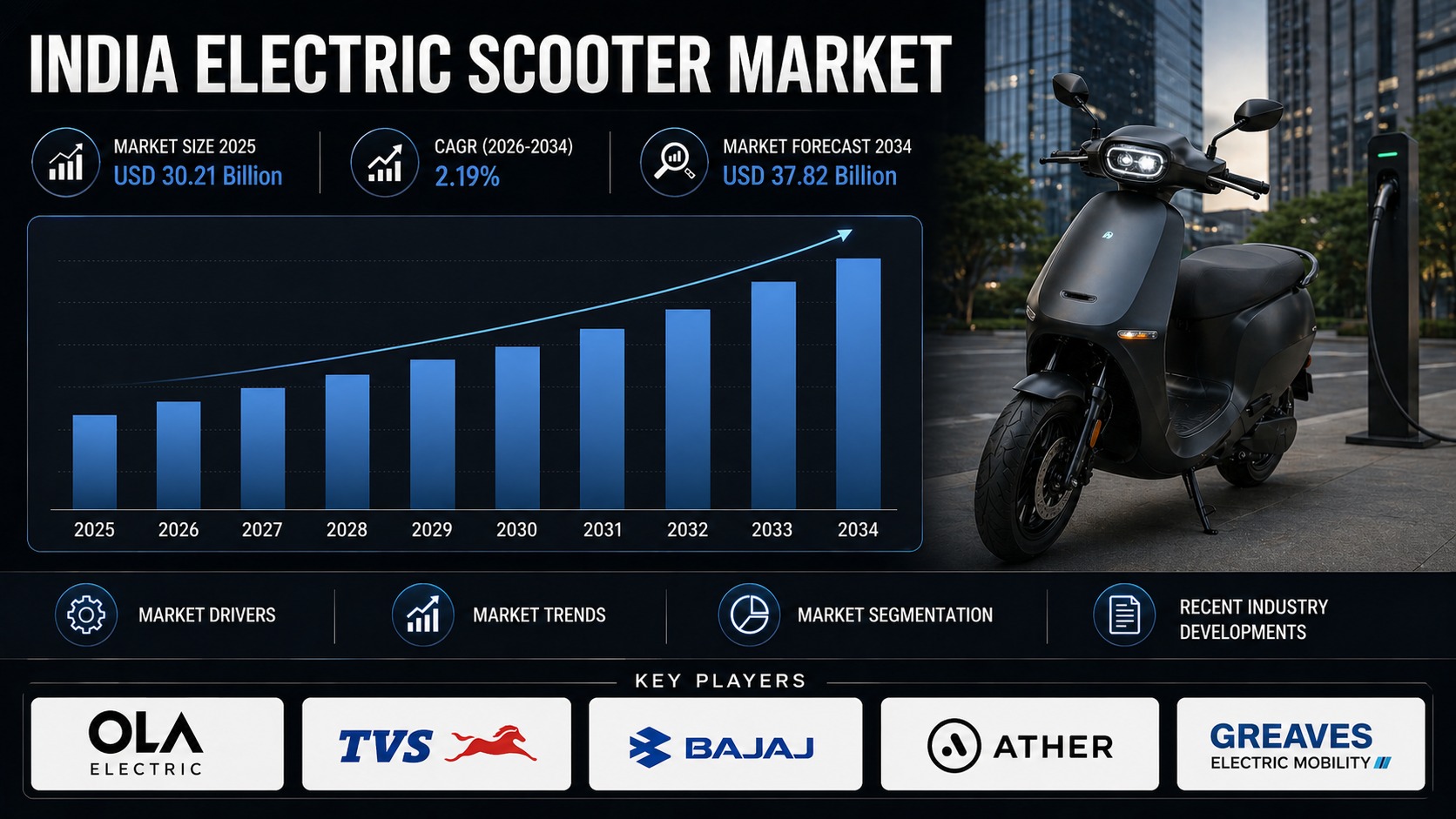
According to IMARC Group’s report titled “India Electric Scooter Market Size, Share, Trends and Forecast by Drive, Battery, Product, Battery Fitting, End Use, and Region, 2026-2034“, The report offers a comprehensive analysis of the industry, including market forecast, electric scooter market share in india, growth, and regional insights.
The India electric scooter market was valued at USD 1.46 Billion in 2025 and is projected to reach USD 3.32 Billion by 2034, expanding at a CAGR of 9.22% during 2026-2034.
The India Electric Scooter Market is undergoing a massive, structurally defining retail transformation, evolving from a highly subsidized automotive experiment into a commercially viable, vertically integrated direct-to-consumer (D2C) retail ecosystem. For B2B automotive distributors, retail network executives, and institutional investors, dominating the EV showroom and localized battery infrastructure pipeline is critical to surviving the imminent obsolescence of traditional two-wheeler dealerships.
- Robust Market Valuation: The market has achieved critical mass, scaling to USD 1.46 Billion in 2025, and is aggressively tracking toward a projected USD 3.32 Billion by 2034.
- Steady Growth Trajectory: Expanding at a 9.22% CAGR (2026-2034), indicating a highly predictable, transitionary revenue stream for the modernized mobility retail sector.
- Technological Dominance: Lithium-Ion batteries command an overwhelming 86.5% retail revenue share, while Hub Motors lead drive configurations at 42.8%, fundamentally standardizing inventory pipelines.
- The Southern Retail Epicenter: South India strictly dictates market velocity with a massive 32.5% regional share, functioning as the premier hub for both gigafactory manufacturing and high-density retail adoption.
- Record Market Penetration: The sector logged a record-breaking 1.28 million retail unit sales in 2025, signaling absolute consumer readiness and validating the commercial viability of mass-market EV retail.
Table of Contents
The CXO Blindspot: How the India Electric Scooter Market is Reshaping the Retail Sector in India
A critical hidden risk for major automotive retail executives is the systemic failure to recognize that electric scooters are a tech-retail ecosystem, not merely a new engine variant. Many legacy dealership networks continue to operate outdated, low-engagement showrooms, completely ignoring the necessary integration of battery-swapping kiosks, at-home charging partnerships, and direct-to-consumer omnichannel digital sales. Failing to upgrade the physical retail environment into an immersive, tech-driven experience center leaves traditional dealers highly vulnerable to agile, digitally native EV brands that are capturing the lucrative urban demographic through proprietary D2C channels.
Ignoring this paradigm shift creates a severe ripple effect that deeply erodes operational margins for the broader automotive retail sector in India. As tech-first EV brands bypass legacy dealer networks in favor of omnichannel experience centers, traditional showrooms face massive footfall attrition and stranded internal combustion inventory. This operational bottleneck completely disconnects traditional B2B distributors from high-growth, subscription-based revenue streams generated by battery swapping and connected-car software upgrades, ultimately isolating slow-moving retailers from India’s urban mobility boom.
➤ Access Industry-Focused Insights and Future Forecasts – Request Sample Report: https://www.imarcgroup.com/india-electric-scooters-market/requestsample
Market Segmentation Breakdown and Share Analysis:
Analysis by Drive:
- Hub Motors (42.8% market share dominate due to low cost, minimal maintenance, and suitability for urban commuters)
- Belt Drive (34.6% Market share serves the premium segment with better performance and brand appeal)
- Chain Drive (22.6% market share remains relevant in budget and rural markets due to easy repairability and low cost
Analysis by Battery:
- Lithium-Ion (leads at 86.5%, driven by FAME II subsidies, longer range, and falling prices)
- Lead Acid (10.8% survives in ultra-budget segments with limited range needs)
- Others (2.7%) include emerging technologies like sodium-ion and solid-state batteries)
Analysis by Product:
- Standard (Most popular for daily commuting)
- Folding
- Self-Balancing
- Maxi
- Three Wheeled
Analysis by Battery Fitting:
- Fixed (Common in high-speed scooters)
- Detachable (Gaining popularity for convenience and swapping)
Analysis by End Use:
- Personal (Dominant segment driven by individual commuters)
- Commercial (Last-mile delivery fleets)
Regional Insights:
- North India (26.4%) growth is policy-driven, especially in Delhi NCR.
- West India (22.1%) benefits from Maharashtra’s subsidies
- East India (19.0%) gains from existing electric mobility adoption trends.
- South India (32.5%) leads due to strong EV manufacturing clusters
By the IMARC Group, the Top Competitive Landscape & their Positioning:
- Ola Electric Mobility Ltd.
- TVS Motor Company
- Bajaj Auto Ltd.
- Ather Energy
- Greaves Electric Mobility Limited
Covering an in-depth analysis of the competitive landscape, market structure, key player positioning, competitive dashboards, top winning strategies, and detailed profiles of all major industry participants you will gain access to all these exclusive insights within the full research report.
India’s Strategic Vision for the India Electric Scooter Market
- Pivoting to Commercial Self-Reliance: By transitioning from the heavily subsidized FAME II scheme toward the EMPS 2024 framework, the government is forcing the retail sector to build structurally profitable, independent business models devoid of perpetual state subsidies.
- Localizing the Lithium Supply Chain: Aggressive Production-Linked Incentive (PLI) deployments aim to establish sovereign domestic manufacturing of Li-ion cells, directly shielding Indian retailers and B2B distributors from extreme global supply chain volatility and import tariffs.
- Expanding Charging Retail Infrastructure: Strategic policy shifts are highly focused on democratizing urban mobility by incentivizing localized battery swapping and dense public charging networks, effectively converting urban real estate into high-frequency EV retail touchpoints.
➤ Explore the Complete TOC and Data Coverage – Get Full Brochure: https://www.imarcgroup.com/request?type=report&id=30913&flag=A
Why Invest in the India Electric Scooter Market: Key Growth Drivers & ROI
- Massive Consumption Base and Density: High-density urban populations and apartment dwellers offer an immense consumer base for electric mobility. Retailers can secure robust ROI by deploying localized battery-swapping networks, transforming a structural charging barrier into a highly lucrative, recurring subscription revenue stream that guarantees high-frequency consumer footfall.
- Policy Support and De-risked Scaling: The strategic government transition toward sustainable manufacturing frameworks, coupled with robust PLI allocations, heavily de-risks localized EV retail. Corporate distributors can leverage these frameworks to secure stable inventory supply chains and scale high-margin dealership networks without heavy subsidy dependence.
- Premiumization and Tech Upgrades: The Indian consumer is rapidly pivoting toward premium, high-performance electric scooters. Retail investors achieve outsized ROI by upgrading traditional showrooms into immersive, tech-driven experience centers that highlight connected mobility, OTA software capabilities, and advanced lithium-ion battery safety, ultimately commanding superior pricing power.
- Supply Chain Efficiencies and Vertical Integration: Strategic vertical integration, specifically localized 4680 cylindrical cell gigafactories, drastically streamlines the EV supply chain. Capturing this domestic production advantage enables retail distributors to circumvent global battery bottlenecks, reduce inventory lead times, and secure premium operational margins across tier-1 markets.
India Electric Scooter Market Trends & Future Outlook
- Disruption via Battery Swapping Retail: High-density urban apartment culture is actively driving the mass deployment of battery-as-a-service (BaaS) swapping stations, establishing a completely new, decentralized retail and recurring-revenue pipeline outside of traditional dealerships.
- The Gigafactory Vertical Integration: Major industry disruptors are aggressively localizing cell technologies and cylindrical cell production, ensuring that downstream retail pricing remains highly competitive and immune to international geopolitical component shortages.
- Hyper-Premiumization of the Segment: The market is witnessing an unprecedented performance escalation; affluent urban consumers are aggressively trading up from high-performance ICE scooters to connected, IoT-enabled premium EV platforms.
- The Rise of East India Retail: While the South dominates, East India is emerging as the fastest-growing frontier, exhibiting an aggressive ~10.5% CAGR, indicating massive untapped retail white space for B2B distributors willing to scale regional dealership networks.
- Stringent Safety Compliance as a Sales Driver: Following historical battery thermal events, strict adherence to AIS-156 safety standards has become a critical retail conversion tool, with consumers prioritizing verified battery stability over base pricing.
Recent News & Developments
Fleet Electrification Accelerates Across Logistics Sector
- E-commerce and last-mile delivery companies are rapidly transitioning to electric scooter fleets, reducing fuel costs, improving operational efficiency, and aligning with sustainability and zero-emission urban mobility mandates.
Shift Toward Advanced Lithium-Iron-Phosphate (LFP) Batteries
- Manufacturers are increasingly adopting LFP battery technology to enhance safety, extend lifecycle performance, and improve thermal stability, particularly suited for India’s high-temperature operating conditions.
Expansion of Charging and Battery Swapping Infrastructure
- Government and private players are investing in scalable charging networks and battery swapping ecosystems, reducing range anxiety and enabling faster adoption of electric scooters across urban and semi-urban markets.
Note: If you need specific information that is not currently within the scope of the report, we can provide it to you as a part of the customization.
➤ Tailor the Research to Your Exact Business Needs – Request Customization: https://www.imarcgroup.com/request?type=report&id=30913&flag=E
Frequently Asked Questions (FAQs):
Q1. What is the current value and projected growth of the India Electric Scooter Market?
According to IMARC Group, the India electric scooter market size reached USD 1.46 Billion in 2025. It is projected to reach USD 3.32 Billion by 2034, exhibiting a compound annual growth rate (CAGR) of 9.22% during 2026-2034.
Q2. Which technology and components dominate the electric scooter retail ecosystem?
Hub motors represent the dominant drive type with a 42.8% revenue share, while Lithium-Ion chemistry commands a massive 86.5% market share, structurally driving inventory and dealership procurement pipelines.
Q3. What are the key trends driving EV retail and regional distribution?
Major trends include the aggressive expansion of battery-swapping infrastructure for urban apartment dwellers, the premiumization of the high-speed scooter segment, and the structural shift from legacy dealerships to direct-to-consumer omnichannel experience centers.
Q4. Which region currently leads the Indian market for electric scooters?
South India strictly dominates with a 32.5% market share, functioning as the nation’s premier gigafactory manufacturing and localized retail adoption capital, heavily anchored by production clusters in Tamil Nadu and Karnataka.
Q5. What are the primary industry challenges faced by regional B2B distributors?
Retail distributors frequently navigate complex challenges related to transitioning away from subsidy-dependent sales models (post-FAME II), building consumer trust through AIS-156 battery compliance, and establishing viable, high-density charging networks in space-constrained metropolitan zones.
Strategic Insight & Verdict
As India’s mobility ecosystem undergoes a definitive technological pivot, we at IMARC Group have observed that the retail distribution of electric scooters is aggressively shifting from a subsidy-driven sales model to a structurally viable, premium experience economy. For retail executives and corporate B2B investors, the verdict is absolute: accelerating investments into omnichannel experience centers, integrating highly scalable battery-swapping networks, and securing localized lithium-ion cell supply chains are strictly non-negotiable imperatives to capture high-margin market share in this rapidly maturing urban sector.
Tarang, Digital Insights Specialist at IMARC Group: https://www.linkedin.com/in/tarang-chauhan-31a82b265/
Verified Data Source: IMARC Group
Contact Us:
IMARC Group
134 N 4th St. Brooklyn, NY 11249, USA
Email: sales@imarcgroup.com
Tel No:(D) +91 120 433 0800
United States: +1-202071-6302
