
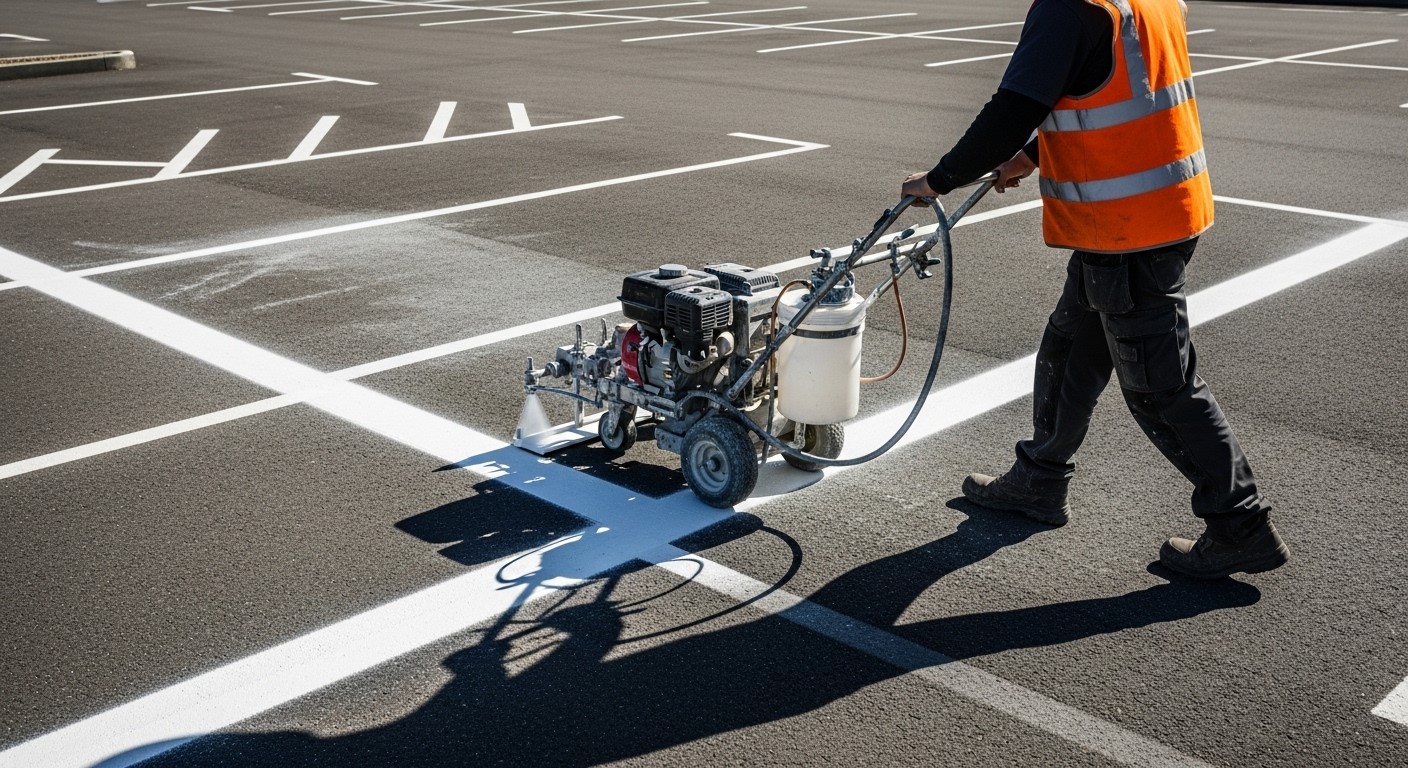
We navigate the world by following lines. Whether driving on the freeway, walking through a busy warehouse, or parking at the local shopping centre, we rely on painted instructions to keep us safe. Line marking is the silent language of our infrastructure. It tells us where to stop, where to walk, and where it is safe to operate machinery.
For business owners and facility managers in Australia, clear and effective markings are not just about aesthetics; they are a critical component of Workplace Health and Safety (WHS). A faded line in a distribution centre can lead to a forklift collision. A confusing car park layout can lead to customer frustration and accidents.
Refreshing or redesigning your facility’s markings is one of the fastest and most cost-effective ways to improve operational efficiency. It transforms a chaotic concrete slab into an organized, compliant, and safe environment. Understanding the types of materials available and the regulations that govern them ensures your investment delivers long-term value.
Table of Contents
The Psychology of the Line
Why do we follow lines on the floor? It is a deeply ingrained psychological response. A solid yellow line creates a mental barrier. We instinctively know not to cross it. A hatched area (diagonal stripes) signals danger or a “no-go” zone.
In a warehouse environment, this psychology is used to separate pedestrians from heavy machinery. By creating designated walkways painted in “Safety Green” or outlined in bright white, you give staff a safe path. Forklift drivers, in turn, know that the marked lanes are their domain. This separation reduces the cognitive load on workers. They do not have to constantly guess where they should be; the floor tells them. This clarity reduces accidents caused by human error.
Materials Matter: Paint vs. Thermoplastic vs. Epoxy
Not all lines are created equal. The choice of material depends heavily on the surface and the traffic volume. In the Australian climate, durability is key.
Road Marking Paint
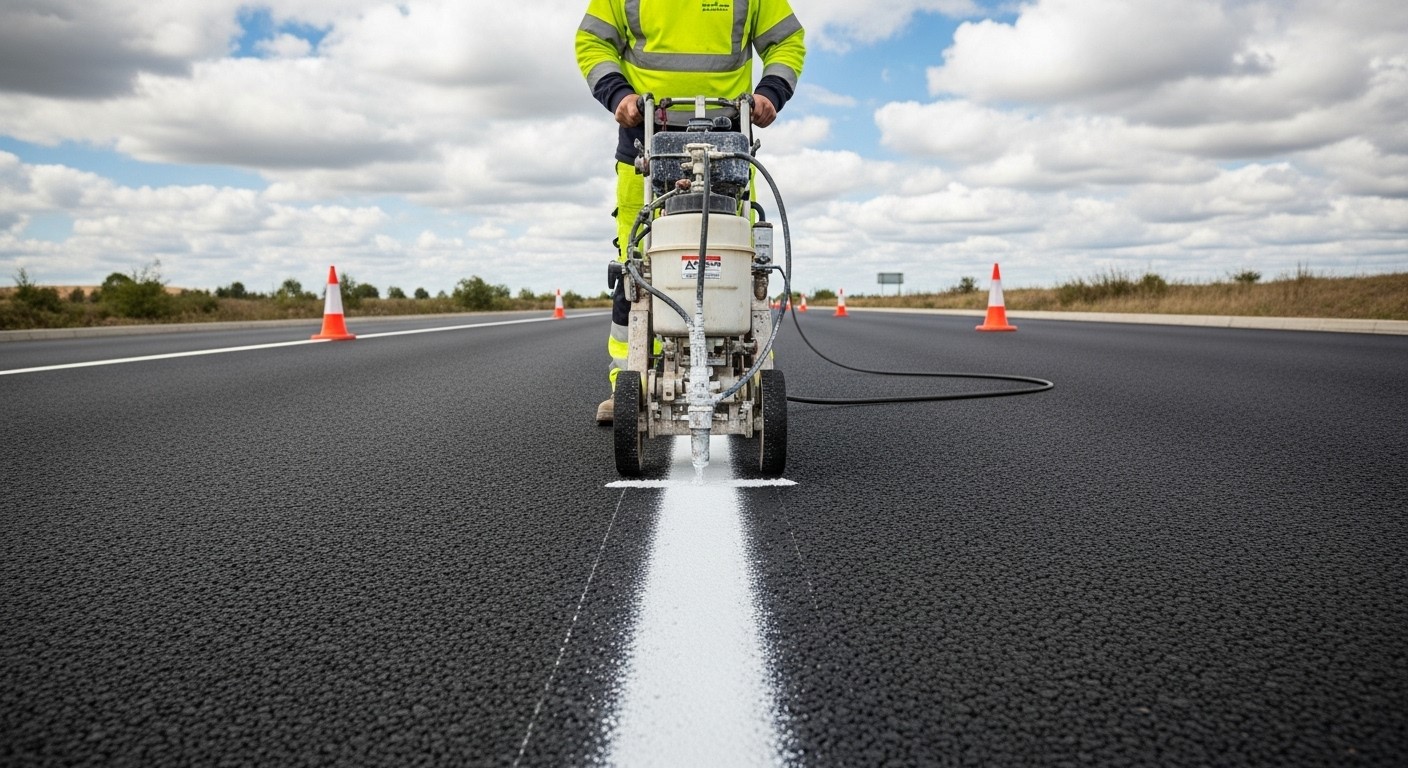
This is the standard for outdoor car parks and asphalt surfaces. It is a solvent-based or water-based acrylic paint. It dries quickly (often within minutes), allowing the area to be reopened to traffic fast. Glass beads can be added to the wet paint to make the lines reflective at night, which is essential for safety in car parks and loading docks.
Thermoplastic
You have likely seen this on public roads. It is a solid polymer material that is melted onto the road surface at high temperatures. It is incredibly durable and sits slightly raised above the surface. It is excellent for high-traffic areas like stop bars and pedestrian crossings where standard paint would wear away in months.
Epoxy Resin
For indoor warehouses and factories, epoxy is the gold standard. It bonds chemically to the concrete, creating a hard, glossy line that is resistant to forklift tyres, oil spills, and chemical cleaning agents. While it takes longer to cure than road paint, it lasts significantly longer in an industrial setting. It is also easier to clean, maintaining its visibility amidst the dust and grime of a working factory.
Navigating WHS Compliance
In Australia, line marking is governed by strict standards, particularly AS/NZS 1906 (Retroreflective materials) and AS 1742 (Manual of uniform traffic control devices).
For a facility manager, compliance means ensuring that your markings meet these codes.
- Fire Exits: Must be kept clear. Using “Keep Clear” stencils and hatched markings in front of emergency doors ensures they are never blocked by pallets or vehicles.
- Disabled Parking: The dimensions of disabled parking bays are strictly regulated to allow for wheelchair access. They must include the international symbol of access and often a shared zone (hatched area) to the side.
- Walkways: Must be clearly defined, usually with yellow lines, and ideally separated from vehicle traffic by physical barriers or generous spacing.
Failing to maintain compliant markings exposes a business to liability. If an accident occurs and SafeWork inspectors find that the safety lines were faded or non-existent, the fines can be substantial.
Optimizing Car Park Flow
A car park is often the first interaction a customer has with a business. If the bays are too narrow, the arrows are confusing, or the layout creates bottlenecks, the customer enters the store frustrated.
Smart line marking design maximizes capacity without sacrificing comfort. It involves calculating the optimal angle for parking bays.
- 90-Degree Parking: Maximizes the number of spaces but requires wider aisles for turning.
- 45 or 60-Degree Parking: Easier for drivers to pull into and out of, requiring narrower aisles, but reduces the total number of bays slightly.
Clear directional arrows, pedestrian crossings (zebra crossings), and “Give Way” bars improve the flow of traffic. They reduce the risk of low-speed collisions and make the car park safer for families walking to the entrance.
The 5S Methodology in Warehousing
Many Australian warehouses adopt the “5S” lean manufacturing methodology (Sort, Set in order, Shine, Standardize, Sustain). Line marking is fundamental to the “Set in order” phase.
Everything needs a place. By painting outlines on the floor for pallets, bins, and trolleys, you create a visual order.
- Red Lines: Often used for defect areas or scrap bins.
- Blue Lines: Used for work-in-progress or raw materials.
- Yellow/Black Tiger Tails: Used to mark hazards like steps, low beams, or electrical panels.
When a tool or pallet is out of place, it is immediately obvious. This organization speeds up workflow. Staff spend less time searching for items and less time moving obstacles out of the way. It streamlines the entire operation.
Surface Preparation: The Key to Longevity
The biggest complaint about line marking is that it peels or fades too quickly. 90% of the time, this is due to poor surface preparation. You cannot simply paint over dirt, oil, or old flaking paint.
Professional contractors will prepare the surface first.
- Sweeping and Scrubbing: Removing loose dust and debris.
- Degreasing: removing oil stains which prevent paint adhesion.
- Shot Blasting or Grinding: For concrete floors, it is often necessary to mechanically abrade the surface to give the paint something to “key” into.
- Blacking Out: If the layout is changing, old lines need to be removed or painted over with black paint (or ground off) to avoid confusion. Ghost lines (where old lines are still visible) can be very dangerous.
Questions and Answers: Common Questions About line marking in Australia
Q: How long does line marking paint take to dry?
It depends on the product and the weather. Standard chlorinated rubber or water-based road paint can be touch-dry in as little as 10 to 20 minutes on a warm, sunny day. However, epoxy paints used indoors typically require 12 to 24 hours to cure before they can accept forklift traffic. It is best to schedule indoor work over a weekend or during a shutdown.
Q: What colours should I use for safety lines?
While there is no single law, Australian Standards provide a widely accepted colour code. Yellow is the standard for aisle ways and traffic lanes. White is used for general production areas or racking outlines. Red is for danger or fire equipment. Green is often used for first aid or safety showers. Blue is used for information or raw materials. Consistency is key across your site.
Q: Can you mark lines on dirt or gravel?
No, traditional paint cannot be applied to loose surfaces like gravel or dirt. It will wash away immediately. For these areas, you need physical markers like bollards, timber edging, or concrete curbing to define the space. Alternatively, you can install concrete strips specifically for the painted lines.
Q: Do I need to repaint my existing lines or remove them first?
If the existing lines are simply faded but sound (not peeling), you can usually repaint directly over them after a good clean. However, if the old paint is flaking or peeling, it must be removed. Painting over flaking paint will just cause the new paint to flake off with the old layer. If you are changing the layout, the old lines must be removed to prevent confusion.
Q: Is line marking slippery?
Standard paint can be slippery when wet. To combat this, contractors add “anti-slip” aggregate (like fine sand or glass beads) into the wet paint. This creates a textured surface that provides grip for shoes and tyres. This is mandatory for pedestrian crossings and walkways in wet areas to meet slip-resistance standards.
Conclusion: Your Path to a Successful line marking in Australia
A fresh coat of paint does more than make a facility look tidy; it imposes order on chaos. It is a visual instruction manual for your site, guiding people safely and efficiently through their day. Whether it is defining a forklift lane to prevent a collision or marking a car park to maximize customer convenience, the lines on the floor are a vital operational asset.
