
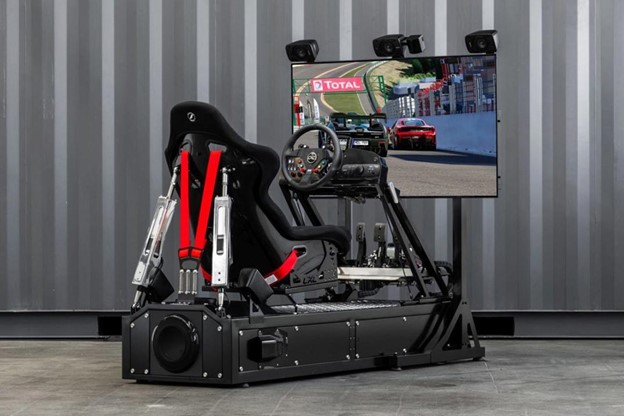
Whether you’re building your first rig or refining a competitive cockpit, the right hardware should adapt to you. Simagic blends realism, comfort, and flexibility, supporting different racing styles while keeping setups clean, intuitive, and ready for the future.
Modern sim racing demands equipment that responds intuitively to driver input while remaining flexible enough to suit different rigs and preferences. Simagic has earned attention for focusing on precision, consistency, and modular design rather than one-size-fits-all solutions. Its ecosystem approach allows drivers to assemble setups that align with space constraints, performance goals, and personal driving habits. Whether the priority is immersion, competitive control, or long-term upgrade potential, understanding how this hardware integrates into complete sim racing systems is essential. This article breaks down where it fits best, how it supports varied driving styles, and what to consider when building or refining a sim racing setup around it.
Table of Contents
A Modular Approach to Sim Racing Hardware
Sim racing setups vary widely, from compact desk rigs to dedicated cockpits. A modular ecosystem allows components to scale with the driver’s needs instead of forcing a full replacement when preferences change.
Why modular design matters
A modular design supports gradual upgrades and tailored configurations:
- Components can be selected individually rather than as fixed bundles
- Drivers can prioritise steering feel, pedal response, or mounting flexibility
- Systems remain adaptable as skills and expectations evolve
This approach reduces compromise. Instead of adjusting driving style to suit hardware limitations, the hardware adapts to the driver’s progression.
Compatibility with Common Rig Configurations
Fit and mounting options play a major role in overall comfort and consistency during long sessions. Hardware that integrates cleanly avoids unwanted flex or awkward positioning.
Desk mounts, wheel stands, and full rigs
Different setups require different considerations:
- Desk and stand users benefit from secure clamping and manageable torque levels
- Cockpit users focus more on rigidity, adjustability, and cable management
- Clean integration supports consistent hand positioning and pedal reach
A well-matched setup reduces fatigue and allows drivers to focus on control rather than compensation.
Force Feedback and Driving Feel
Driving feel is central to immersion and performance. Force feedback should clearly communicate grip, weight transfer, and surface detail without overwhelming the driver or masking important cues.
Different drivers interpret feedback in distinct ways. Smooth drivers typically prefer progressive resistance with refined, subtle detail that supports clean inputs. More aggressive drivers rely on immediate responses and firm centring to react quickly during corrections. Endurance-focused drivers place greater value on consistency, ensuring the steering feel remains stable and predictable throughout long sessions.
When feedback is balanced correctly, it allows drivers to react instinctively. This reinforces muscle memory, improves confidence, and enhances control without becoming a distraction during critical moments.
Steering Inputs and Control Precision
Precise steering input allows drivers to place the car accurately, especially during corner entry and correction phases.
Matching steering response to technique
Control precision affects driving confidence in several ways:
- Linear response supports predictable cornering
- Minimal latency improves correction timing
- Stable centring enhances straight-line confidence
When steering behaviour aligns with driving habits, learning curves shorten and lap-to-lap consistency improves.
Pedal Integration and Braking Styles
Pedals play a decisive role in how drivers control braking zones, manage trail braking, and balance throttle input. The way a pedal set responds directly affects confidence under braking, making compatibility and adjustability essential within any sim racing setup.
Drivers naturally approach braking in different ways. Some rely on pressure-based feedback, using resistance to judge braking force with precision. Others prefer longer pedal travel, allowing them to modulate input gradually through movement rather than force. Many adopt a hybrid approach, where adjustable tuning supports both pressure and travel sensitivity.
A flexible pedal configuration respects these differences. Instead of forcing drivers to adapt their habits, it allows them to preserve natural braking techniques, improving consistency and reducing the time needed to feel fully in control.
Adjustability for Ergonomics and Comfort
Comfort is often overlooked but directly affects performance. Poor ergonomics lead to fatigue, inconsistency, and reduced session length.
Ergonomic considerations in setup design
Key ergonomic factors include:
- Steering height and angle
- Pedal spacing and inclination
- Seating position relative to wheelbase
Hardware that accommodates fine adjustments supports longer, more focused sessions without strain.
Software Tuning and Personalisation
Hardware performance is significantly enhanced through careful software configuration. Tuning tools allow drivers to fine-tune steering and pedal response without making physical adjustments, ensuring the setup feels refined and controlled rather than overwhelming.
Effective tuning focuses on aligning feedback strength with personal comfort thresholds, so important cues remain clear without causing fatigue. It also involves filtering out unnecessary noise while preserving surface detail and load changes that inform driving decisions. Many drivers benefit from creating multiple profiles, allowing settings to adapt to different disciplines or personal preferences.
Through software personalisation, a sim racing setup can evolve naturally alongside driver skill. As experience grows, adjustments can be made gradually, maintaining familiarity while unlocking greater precision and confidence.
Progression from Casual to Competitive Use
Many drivers start sim racing at a relaxed pace before gradually aiming for greater consistency and competitive control. For this transition to feel natural, hardware must support progression without forcing major changes to driving habits or control inputs.
A future-ready setup provides enough headroom for increased torque or sensitivity as confidence grows. It also remains compatible with more rigid rigs, ensuring stability as overall system demands increase. Just as importantly, it delivers consistent behaviour across upgrades, so steering and pedal feel remain familiar.
This continuity is crucial. By avoiding sudden changes in response or feedback, drivers can focus on refining technique and racecraft rather than relearning basic inputs as performance expectations rise.
Common Setup Mistakes to Avoid
Even quality hardware can underperform if configured poorly.
Pitfalls that reduce performance
Common issues include:
- Over-tightening force feedback beyond comfort
- Ignoring ergonomics in favour of raw power
- Inconsistent mounting leading to flex or vibration
Addressing these early improves both enjoyment and results.
Building a Balanced System
The most effective sim racing setups prioritise balance over extremes. Each component should complement the others.
Key principles for balanced setups
A cohesive system focuses on:
- Matching feedback strength to rig stability
- Aligning control sensitivity with driving style
- Maintaining comfort over long sessions
Balance ensures performance gains feel natural rather than forced.
Conclusion
A well-designed sim racing setup is not defined by individual components alone, but by how effectively they work together to support the driver. Simagic fits into this philosophy by offering flexibility, precision, and scalability across a wide range of setups and driving styles. Its modular nature allows drivers to build systems that evolve with experience, while consistent feedback and adjustability support both smooth and aggressive techniques. By focusing on ergonomics, thoughtful tuning, and balanced configuration, drivers can create environments that enhance control without adding unnecessary complexity. Ultimately, the right setup reinforces natural inputs, builds confidence, and keeps performance consistent session after session. When chosen and configured carefully, Simagic becomes less about hardware presence and more about enabling the driving experience itself.
