
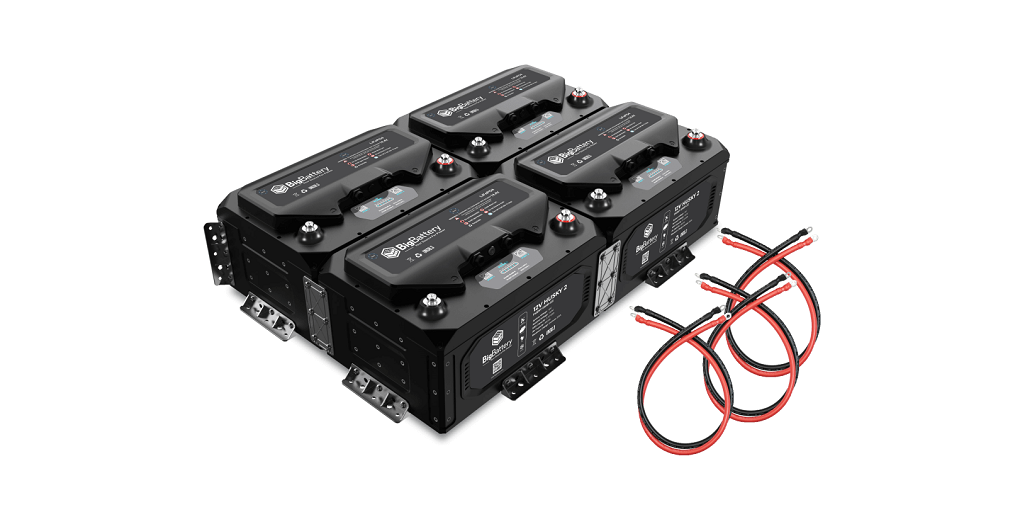
It’s no secret that lithium batteries of many different types are available to the modern market and that moreover they offer a significant number of advantages when compared to lead-acid batteries.
But did you know that when you upgrade to a lithium alternative like a LiFePO4 lithium battery as opposed to a lead-acid battery (such as for an RV, boat or golf cart) you won’t have much to do with the following 4 problems?
Try yourself and see if you knew these.
Table of Contents
Sulfation
Lead-acid batteries have lead plates in their interior (which is one reason they’re so heavy, by the way). These lead plates can accumulate sulfate crystals (which is called sulfation) for any of various reasons. For instance, the plates can experience sulfation when undercharged or when left in a discharged state for too long.
Unfortunately, the process is not reversible and a sulfated battery will lose cranking power, take longer to charge, experience shorter battery life, and eventually fail altogether. Lithium batteries do not experience this specific problem.
Out of the Blue Battery Deaths As a Result of Self-Discharge
Self-discharge refers to the phenomenon that occurs when a battery is left idle for too long, and some of the charge literally “leaks” away.
All batteries self discharge, but lead-acid batteries tend to self-discharge at a rate between 3% and 15% per month. In just a few weeks of disuse, a lead-acid battery can lose a substantial amount of charge. Go too long, and you’ll be greeted by a stone-dead battery, even if it was fully charged when you originally stored it.
Lithium batteries are more tolerant of being left idle because they do not self discharge as quickly. Normally they only lose between 1% and 3% per month.
Corroded Terminals
A lead-acid battery’s terminals can experience discharge and corrosion for any of several reasons. The main causes are battery age, as well as over and undercharging.
A little bit of corrosion can be scrubbed away with a terminal cleaner or a brush, but corrosion will damage the terminals over time, and moreover, corrosion will make it difficult to establish solid connections between the leads and terminals.
Lithium batteries are much lower in maintenance requirements than lead-acid batteries and as a general rule, will not experience conditions that cause battery terminal corrosion.
Unwieldy Size and Weight
This is a basic one but it is one to consider nonetheless. Lithium batteries of all sorts have higher energy density than lead-acid batteries, which means a smaller mass can contain a higher charge potential.
Therefore, comparable lithium batteries and lead-acid batteries are usually mismatched in size, weight, and footprint. Lithium alternatives are lighter and more compact, making it easier to handle, store and transport them.
Here for a New LiFePO4 Lithium Battery?
Whether or not you’ve experienced these issues with lead-acid batteries or you’ve just determined that now’s the time to make an upgrade to more powerful, longer-lasting lithium batteries, visit BigBattery.
BigBattery carries a wide range of LiFePO4 lithium batteries for golf carts, marine applications, RVs and campers, and more. Explore their collection or get in touch with them if you want to learn more about the relative advantages of lithium batteries and they will be more than happy to help.
For More Information About 48v Lifepo4 Battery and Solar Battery For Home Please Visit: Bigbattery.
